Why They Leave a Perfectly Good Bed
They do not, until they have to. A harbourage next to a nightly host is as good as it gets, and an insect in one has no reason to go anywhere.
Expansion happens for one reason: the good places fill up. As the population grows, the mattress seams and the frame joints reach capacity, and the surplus has to sit somewhere. So they take the next best thing, which is whatever is closest.
That is why the spread within a room is so orderly, and why the order is readable in reverse — the further out you find evidence, the longer it has been going.
The Order, and Roughly How Long
- Mattress piping and seams, head end. Where it starts. Weeks
- The rest of the mattress, and the top of the base or frame. Weeks to a couple of months
- Frame joints, divan drawers and the underside of the base. A few months
- Behind the headboard, particularly a wall-fixed one
- Bedside furniture — drawer backs, runners, the recess
- The skirting line and carpet edge on the bed wall
- An upholstered chair in the room, if there is one
- Behind pictures and fittings above the bed. Long-running
Those timings are indicative rather than precise — temperature, how often the room is disturbed and how available a host is all change the pace. The order, though, is reliable.
Which is why an inspection reads distance as time. Evidence confined to the mattress piping means recent. Evidence in the bedside cabinet and at the skirting means it has been going for months and the room, not the bed, is the job.
The Two Things That Speed It Up
1. Pressure from numbers
A large population expands faster than a small one, for the obvious reason. It is not linear either: as the good harbourages saturate, the rate at which insects have to look elsewhere increases.
2. Disturbance
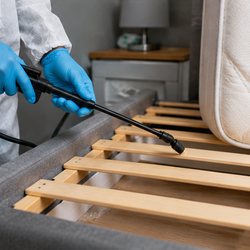
This is the one worth knowing about, because it is self-inflicted. Spraying a harbourage, or repeatedly disturbing one, drives insects out of it and into the next available gap — which is further from the bed than where they started.
That is the mechanism behind one of the more counter-intuitive facts in this trade: a room that has been treated repeatedly by a householder with shop-bought products is often more widely spread than an equivalent room left alone.
What Slows It Down
- Nothing much, while a host is present. There is no stage at which an untreated population declines on its own
- A cool room slows development, which slows growth — but it also extends how long they survive without feeding
- Fewer available gaps. A sparse room with a metal frame and hard floors genuinely offers less to expand into than a cluttered one
- Not disturbing them, which is the only one you control before a treatment
Caversham: Where the Living Room Comes In
Self-propelled spread accounts for a room. It does not account for a sofa on a different floor — that is too far, and there is nothing drawing them to it.
So when a living room becomes involved, something was carried or somebody moved. Both matter, and they are worth separating when you describe the problem: activity spreading outward across one bedroom is a timeline, and activity appearing downstairs is an event.
Do not treat the outward spread as a reason to strip the room. Emptying a room with a spreading population disperses it further and into whatever you carry out. The answer to a room that is filling up is a treatment of the room, not a clear-out.
Bed bugs in Caversham? Pest Control Specialists Berkshire treats bed bugs from £220 for the first room. Bed Bug Treatments in Caversham has the full detail, or call 0118 336 1366.