1. It Goes Where They Are Not
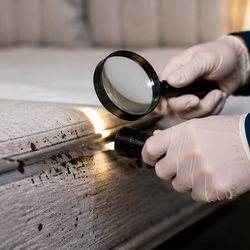
The biggest reason and the least obvious. A bed bug sits in a gap that touches it on both sides — inside a seam, in a countersunk screw hole, behind a headboard, in the fold of a stapled fabric edge.
An aerosol goes where it can be aimed, which is open surfaces: the top of a mattress, the face of a frame, the floor. Those are precisely the surfaces they do not sit on.
So the product arrives everywhere except the twenty or so places that matter, and the fact that it kills bed bugs on contact is not much use when it does not reach any.
2. Contact Kill Versus Residual Effect
Most household aerosols are essentially contact products: they work on an insect they land on. That is fine for a wasp on a windowsill and close to useless for an animal that spends ninety-nine per cent of its life out of sight.
What a bed bug treatment needs is something that stays where it is put and is encountered by insects moving through a harbourage over the following days — which is a different kind of product used in a different way, into the gaps rather than onto the surfaces.
3. Nothing Reaches the Eggs
Eggs are cemented into the tightest part of a harbourage with a shell around them, and they hatch on their own schedule — a week or two at room temperature.
That produces the pattern everybody recognises: a household sprays, things improve markedly for a fortnight, and then it comes back. That is not the product wearing off. It is the generation that was never affected arriving on time.
4. It Disperses Them
The one that actively costs you. Disturbing a harbourage — spraying into it, or repeatedly poking about in it — drives insects out of it and into the next available gap, which is further from the bed and sometimes in the next room.
A room that has been sprayed repeatedly over months is often more widely spread than an equivalent room left alone, and it is harder and more expensive to deal with as a result.
The honest summary. A shop spray is not a weak version of a treatment. It is a different thing used a different way, and its main measurable effects are a fortnight of apparent improvement and a wider distribution afterwards.
What About Resistance?
Worth mentioning and worth not overstating. Resistance to some insecticide groups is documented in bed bug populations internationally, and it is one of the reasons this is a harder pest than it was fifty years ago.
It is not, though, the main reason a household aerosol fails in a bedroom. The first three reasons on this page would defeat a perfectly effective product used the same way, and they are the ones that apply in almost every case.
The Other Shop Products
- Foggers and bombs. Fill a room with a fine mist that settles on open surfaces. Same problem as the aerosol, with more dispersal and more disturbance
- Powders. Some have a genuine place in professional use, applied into specific voids. Scattered over a carpet by a householder they do very little and create a mess that has to be cleared before anything else can happen
- Plug-in repellers. No
- Sprays sold as natural or plant-based. Mostly contact products with the same limitation, and the same fortnight of apparent success
Maidenhead: If You Have Already Used Something
Most households have and it is not a disaster. What it means is worth saying plainly when you call.
- The population may be more widely spread than the evidence suggests
- Residue on surfaces can affect what is usable on them afterwards
- The evidence may have been disturbed, so the picture is less readable
- The room may need a wider inspection than it otherwise would
All four are manageable when they are known about. None of them is manageable when they are discovered halfway through a visit.
Do not spray again while waiting for a treatment. It is the hardest advice to follow, because doing nothing feels like giving up. What it actually does is widen the job you are about to pay for.
Bed bugs in Maidenhead? Pest Control Specialists Berkshire treats bed bugs from £220 for the first room. Bed Bug Treatments in Maidenhead has the full detail, or call 0118 336 1366.