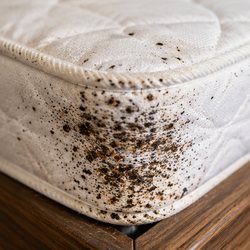
Why the Evidence Matters As Much As the Treatment
An inspection is not just establishing whether there are bed bugs. It is establishing where the harbourages are, how far the population has spread, and roughly how long it has been running — because those three things decide what gets treated and how widely.
All three are read from physical traces: where spotting sits, whether there are cast skins, how far from the bed the evidence goes. Remove the traces and the job has to be planned from guesswork.
The distance evidence sits from the bed is a clock. Confined to the mattress piping means recent and contained. Out at the skirting means months, and means the room rather than the bed. Clean the room and that reading is gone.
1. Cleaning the Seams Out
The natural response to finding black specks along a mattress piping is to clean them off. It removes the single most informative thing in the room: the spotting, its concentration and its distribution.
If your preparation instructions ask for vacuuming with a crevice tool, do it. Scrubbing a seam clean before anybody has seen it is a different thing.
2. Deep Cleaning the Room
Washing surfaces down, shampooing a carpet, wiping out drawers. It removes perimeter evidence in particular, which is the part that says how long this has been going on and whether the room is the job rather than the bed.
3. Squashing the Specimen
A flattened insect on kitchen roll loses the shape, the profile and usually the legs. An intact one settles identification in seconds — and rules out carpet beetle, fleas and spider beetles, all of which are regularly reported as bed bugs and none of which is treated the same way.
Tape, a jar or a small sealed bag. If it is on your skin, do whatever you like; nobody is asking anybody to be calm about that.
4. Throwing the Item Out
An infested mattress or chair in a skip is an item nobody can examine. It was very likely the primary harbourage, and how much was in it and where is exactly what would have told somebody how far this has gone.
It also means the route it took out of the house is now part of the question, and nobody can tell how much it shed on the way.
5. Spraying
Two separate harms, and this is the second one: an aerosol scatters a population out of the harbourage it was sitting in. Afterwards the traces are in one place and the insects are in another, which is a very misleading picture to inspect.
6. Tidying the Room Before the Visit
Understandable, and it costs you. Where things were — the boxes under the bed, the pile of clothes on the chair, what was in the drawers — is part of how somebody works out where activity is and where it might have travelled.
Clear for access, which is what preparation asks for. Do not clean for appearance, which is what nerves ask for.
What To Do Instead
- Photograph everything you find, in place, before you touch it
- Wide, then medium, then close, with something for scale
- Write down where, and the date
- Keep any specimen, sealed
- Leave the rest of the evidence exactly where it is
- Do the preparation you are asked for, and nothing more
Hungerford: If You Have Already Done Some of It
Most people have, and it is not a disaster — it just needs saying. An inspection that knows the seams were cleaned, or that the room was sprayed, or that the mattress went out last week, is working with a known gap rather than a false picture.
The false picture is the expensive version: a room that looks lightly affected because it was cleaned, treated as a light infestation, and back in six weeks.
Photograph before you do anything at all. Even the smear test damages the mark you use it on. Whatever you are about to do to the evidence - test it, catch it, clean it, bin it - one photograph in place first costs nothing and cannot be recovered later.
Bed bugs in Hungerford? Pest Control Specialists Berkshire treats bed bugs from £220 for the first room. Bed Bug Treatments in Hungerford has the full detail, or call 0118 336 1366.