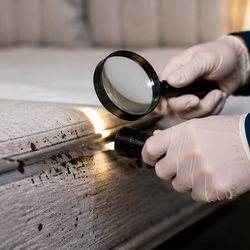
Where They Actually Are in a Mattress
Not inside it. A mattress is a sealed textile envelope over springs or foam, and there is no route into that interior for an insect that walks. What a mattress offers is its outside geometry, and that is entirely accessible.
- The piping that runs round the top and bottom edges — a continuous covered channel, and by a distance the most productive place on the whole item
- The seams either side of it
- Under the labels, which are stitched at one edge and lift
- Inside the handle recesses, where they are fitted
- The vent grommets, if it has them
- The tufting buttons, on a traditional mattress
Every one of those can be reached, opened out and worked along. That is the whole argument, and it is why the answer for a mattress differs from the answer for a piece of upholstery whose frame sits behind a stapled dust cover.
The test that decides any item, not just a mattress. Can the inside be reached? For a mattress the answer is that there is no inside to reach — the harbourage is all on the surface geometry. That is what makes it treatable.
The New Bed Trap
This is the expensive version of the mistake and it runs the same way every time.
- The mattress goes out, usually carried down the stairs
- The room is not treated, because the problem appears to have been dealt with
- A new bed arrives into a room with an active population in the frame, the divan and the skirting
- It is colonised within weeks — and it is now a new mattress with bed bugs in the piping
- The treatment happens anyway, several hundred pounds later
If you are going to replace a bed, replace it after the room has been dealt with and after you have been told it is ready. Ordering it on day one is money spent on the wrong week.
Encasements: What To Buy Instead
A bed bug proof encasement is a fully zipped cover that seals a mattress, and usually a matching one for the base. Fitted after a treatment it does three genuinely useful things.
- It seals the geometry. Piping, seams, labels and handles are all inside the cover, so nothing can establish in them again
- It turns every future check into a glance. A smooth zipped surface takes five seconds to read; a piped seam takes minutes
- It contains anything missed. Sealed in, with no route out to a host
Things worth knowing before you buy one. It has to be a bed bug PROOF encasement rather than a waterproof protector — the difference is the zip and the fabric weave, not the marketing. It needs to stay on rather than come off with the sheets. And it is not a treatment: fitted over a live infestation it seals the problem in with the mattress and does nothing about the frame, the base or the room.
When a Mattress Genuinely Is Finished
It does happen, and it is usually about the mattress rather than about the bed bugs.
- The cover is split or torn, so there IS now a route into the interior
- It is already at the end of its life and was going anyway
- It has been soaked in a shop-bought product by somebody trying to deal with it themselves
- It is heavily soiled for unrelated reasons
Notice that only the first of those is a bed bug reason. If a mattress is sound, the presence of bed bugs on its own is not an argument for skipping it.
The Bedding Is a Separate Question, and an Easy One
Sheets, duvets, pillows, protectors and mattress toppers all go through a hot wash and a full hot tumble dry cycle, which deals with them completely. The dryer is doing most of that work, so a hot wash followed by line drying is half the job.
Pillows in particular get thrown out unnecessarily. Unless the care label rules out the heat, they wash and dry like anything else.
If a mattress does have to go, it leaves the room wrapped. Heavy polythene and tape, before it moves, and cut or marked so nobody takes it off the street. An unwrapped mattress on a pavement gets collected by somebody — and that is how a problem gets handed on rather than disposed of.
Bed bugs in Berkshire? Pest Control Specialists Berkshire treats bed bugs from £220 for the first room. Bed Bug Treatments Berkshire has the full detail, or call 0118 336 1366.