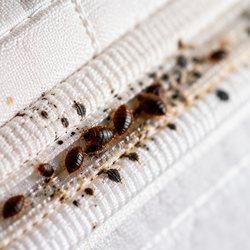
Dark Spotting: Tells You Where They REST
Digested blood, deposited by an insect sitting still. It looks as though somebody touched the fabric with a fine felt tip, and it smears rust-brown when wiped with a damp white cloth — dry dirt brushes off instead.
What it tells you. Spotting marks the harbourage, not the feeding site. It is deposited where they sit between meals, so a concentration of it is a place worth treating and a scatter of it is probably something else. Its distribution is the useful part: confined to the mattress piping means recent; out at the skirting line means it has been running long enough to fill everything nearer the bed.
Cast Skins: Tell You It Is BREEDING, Not Just Present
Pale, papery, translucent, exactly the shape of the insect and split along the back. A bed bug passes through five stages between hatching and adult and sheds at each one, so a single insect reaching maturity leaves several behind.
What it tells you. This is the difference between an introduction and an infestation. One insect carried in on a bag leaves no cast skins. A collection of them means a population has been developing in that spot, feeding successfully, for weeks at least. It is the single most informative thing most people find.
Eggs: Tell You You Have Found the Right Place
About a millimetre, pearly white, and cemented into a seam or joint rather than resting loose. If it shakes free, it is not an egg.
What it tells you. Eggs are laid where the insects live rather than where they feed, so finding them means you are looking at the harbourage itself rather than at a place they pass through. It also tells you why a follow-up visit is normal work: an egg cemented into a joint is more sheltered than the insect that laid it.
Live Insects: Tell You the Least
Adults are four to five millimetres, oval, flat, reddish-brown and wingless at every stage. Straight after a meal they are rounder and much darker, which is why somebody who finds one of each is often convinced they have two different insects.
What it tells you. Surprisingly little on its own. A single insect on a floor could have arrived on a bag last night. A single insect in a harbourage, with spotting and cast skins around it, is a different proposition entirely — and it is the context doing the work, not the insect.
One insect and nothing else is genuinely ambiguous. One insect plus spotting, or plus cast skins, is not. If you find a single bed bug and no other evidence at all, check again in a week and again a fortnight after that rather than either panicking or dismissing it.
Why Bites Are the Weakest Evidence of All
It is where nearly everybody starts and it proves the least. Reaction varies enormously between people: some react within hours, some take days, and a significant proportion show no visible reaction at all.
So two people can share a bed and an infestation while only one of them has anything to show for it — which regularly leads a household to blame the laundry, or one person's imagination.
It runs the other way too. Bites in a line or a cluster get described as diagnostic and they are not. Plenty of things bite at night, and skin reactions that are not bites at all can look similar. A pharmacist or GP can advise on the skin. Only a look at the room can tell you what caused it.
The Three Situations With No Signs At All
- Nobody in the household reacts. The population develops for months with nothing to prompt anybody to look
- The room has no regular occupant. A guest room or spare room produces no bites because there is nobody to bite, while evidence quietly accumulates in the seams
- A mattress protector is fitted. It covers the exact strip of piping where first evidence appears, which is why a check means stripping the bed properly rather than looking at it
Photograph what you find before you touch it. Evidence in place is worth far more than evidence in a bag - where it was found is half of what it tells anybody. It also settles identification in seconds, which is the single most useful thing you can do on the phone.
Bed bugs in Berkshire? Pest Control Specialists Berkshire treats bed bugs from £220 for the first room. Bed Bug Treatments Berkshire has the full detail, or call 0118 336 1366.