
Living Next to a Lot of Ants
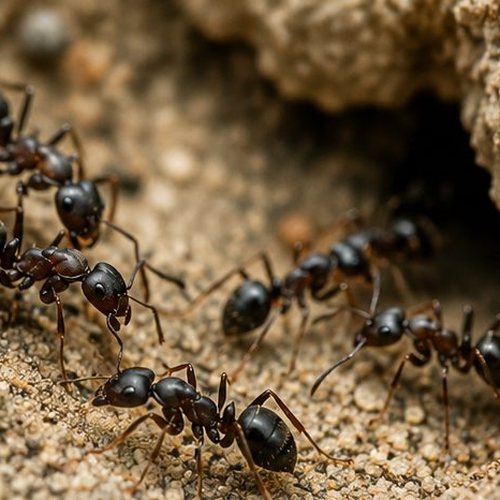
Open ground, hedges and woodland edges hold nests of several kinds. Most of them are no concern at all. Yellow meadow ants build soil mounds in rough grass and paddocks and rarely come indoors. Red ants live in grass and under stones and can give a mild sting if disturbed. The one that actually comes into homes is the black garden ant, which nests close to buildings under paving, at wall bases and in borders.
So the ants on the lawn and in the field are best left alone. What needs attention is the colony whose workers are walking into your kitchen, and that one is nearly always within a few metres of the house. If you are unsure which ant you are looking at, our page on which ant it is sets out the differences.
Old Walls, Stone Floors and Gaps
Rural houses are often older, extended in stages and built with materials that leave gaps: lime mortar that has softened, stone or brick floors laid on earth, timber sills, and joins where one phase of the house meets another. Each of those is a way in, and some give ants somewhere to nest inside the building itself.
Ants coming up through a flagstone floor, out of the foot of a wall or from under a hearth are nesting inside or right beneath the house rather than wandering in from the garden. Nests in walls and under floors have their own page on ants in walls and floors.
Garages, Sheds, Stables and Barns
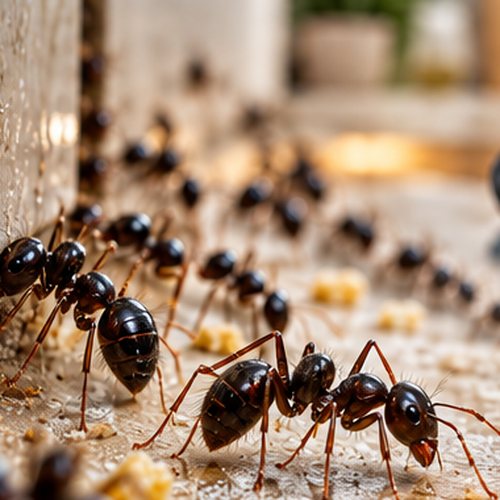
Outbuildings suit ants well. They are dry, rarely disturbed, often have earth or broken concrete floors, and frequently hold things ants want: bird seed, animal feed, a spare fridge, a box of fallen apples, bags of compost. A nest in the base of a shed wall is no great problem in itself, but if the building stands close to the house the workers soon find the back door as well.
- Keep bird seed, pet food and animal feed in sealed metal or hard plastic bins, not in open sacks.
- Store fallen fruit, jam-making sugar and drinks in closed containers.
- Clear leaf litter and soil banked against the base of timber buildings.
- Tell us about stables and outbuildings when you ring, and which ones hold animals or feed.
The one thing that helps most: keep soil, logs and planting away from the house walls, the airbricks and the damp-proof course. A clear strip at the base of the wall takes away the nesting spot closest to your door.
How We Treat a Rural Property
The first job is finding which nest is sending ants into which building, which on a larger plot takes some walking about on a warm day. The general approach to that is in how to find an ant nest. We then use gel bait placed in cracks and out of reach indoors and in outbuildings, and a residual insecticide at the nest, the entry points and the outside wall base. Nests out in fields and hedgerows that are causing no trouble are left alone.
Please mention children, dogs, cats, horses, chickens, ponds, fish tanks or anyone vulnerable when you book, so bait and treatment go where animals and people will not reach them. Treated areas stay clear until dry and for as long as we advise. Ant control in Pangbourne is a fixed £240, confirmed before anything is booked, with what the treatment involves explained at the same time.