The Insect You Can See Is Not the One Eating Your Carpet
This is the single most useful thing to understand about carpet moths, and almost everything else on this page follows from it.
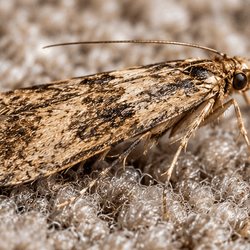
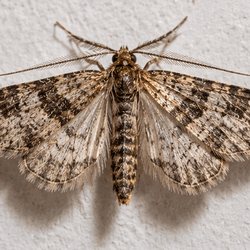
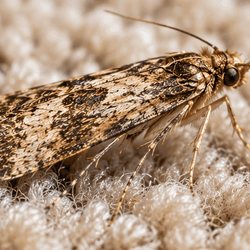
The adult moth fluttering across your living room does not feed on wool. It has no interest in your carpet except as somewhere to lay eggs. The damage is done by the larvae — small, cream-coloured, and living somewhere dark and undisturbed where you are not looking.
So the visible stage and the damaging stage are two different things in two different places. Once that is clear, a lot of otherwise puzzling behaviour makes sense at once.
- Why it is found late. The damage accumulates out of sight and the moths only appear at the end of a cycle
- Why killing moths achieves nothing lasting. You are removing the stage that does not feed
- Why it seems to go away and come back. Adults emerge in waves, so sightings fall away naturally between generations
- Why DIY sprays disappoint. They go on open floor; larvae are under the furniture and along the edges
- Why treating one room often fails. The moths were seen in that room; the larvae were in another
The practical version. If you have seen moths, do not reach for a spray. Move something heavy — a wardrobe, a bed, a sofa — and look at the carpet underneath it. That ten minutes tells you more than anything you can buy.
What Carpet Moths Actually Are
Carpet moths are small household moths whose larvae feed on keratin, the protein found in animal fibres. Wool is the obvious source. So are silk, feathers, fur, animal hair and the debris that collects where those things are.
They are poor and reluctant fliers. An adult disturbed from a carpet edge is more likely to run into a corner than to fly across the room, and they are not drawn to lights. If the moths in your house are circling a lampshade, they are probably something else entirely.
Synthetic carpet — nylon, polypropylene, polyester — is not food and cannot sustain an infestation. That is a genuinely useful fact, because it means establishing what your floor is made of can rule the floor out in about a minute.
Signs of a Carpet Moth Infestation
Adult moths are the sign people notice. These are the signs that actually confirm it.
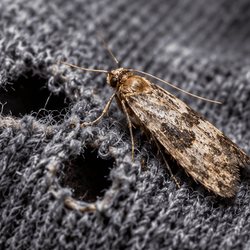
- Small moths crawling or making short flights close to the floor
- Bare or thinning patches in wool carpet, irregular rather than neat
- Damage along carpet edges and where the carpet meets the skirting
- Bare areas revealed when a bed, sofa or wardrobe is moved
- Small cream larvae within the carpet pile
- Fine silky webbing, sometimes with grains of debris caught in it
- Shed larval cases, which look like small grains of the carpet itself
- A fine sandy debris where an item has been standing
- Damage to rugs, usually visible on the underside before the pile
- Moths appearing repeatedly in the same room
If you are finding adults regularly, the useful response is not to look harder at the open floor. It is to look under things.
Where Carpet Moths Hide
Activity concentrates wherever there is a food source and nothing disturbs it. In practice that means:
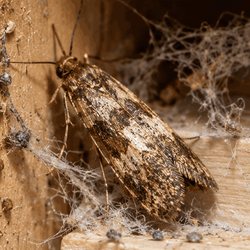
- Under beds, sofas, wardrobes and chests of drawers
- Along carpet edges and against skirting boards
- Beneath rugs, and on their undersides
- Inside fitted and built-in cupboards, at the back and the base
- On stairs, at the outer ends of the treads where nothing walks
- In spare rooms and any room whose door stays shut
- In lofts, garages and outbuildings where textiles are stored
- Wherever wool clothing, blankets or throws are kept
Vacuuming the open centre of a room is therefore the one part of the job that was never necessary. It is not a criticism of anyone's cleaning — it is simply that the middle of the floor is the part that gets walked on, and larvae will not settle there.
It Is Not Always the Carpet
Worth saying plainly, because it sends a lot of people looking in the wrong place. Keratin is in more of a house than the flooring.
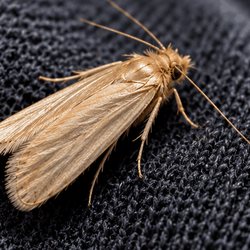
- Underlay, particularly felt-based, which sits in permanent darkness beneath the carpet
- Wool rugs, which are frequently the source even where the fitted carpet is synthetic
- Upholstery — wool covers, horsehair stuffing, and the hessian and webbing underneath
- Curtains, especially heavy interlined ones, at the hem
- Feather and down in cushions, pillows and duvets
- Sheepskins, hides and taxidermy, which are the densest keratin in most homes
- Stored woollens in wardrobes, lofts and boxes
- Felt in unexpected places, including inside pianos
If you have moths and no carpet damage at all, that does not mean you were mistaken. It usually means the food source is one of the above.
Damage to Wool Carpets and Rugs
Wool carpet is the most valuable thing carpet moths commonly get into, and the damage does not repair itself.
It typically begins as a thin or grazed area rather than a clean hole, spreads outwards from wherever conditions are best, and becomes obvious when furniture moves. On a good wool carpet the cost of the damage overtakes the cost of the treatment fairly quickly, which is the honest financial argument for looking properly rather than assuming it will pass.
How Much Does Carpet Moth Treatment Cost? From £220
Our professional carpet moth treatment across Berkshire starts from £220. We publish that because people are entitled to know roughly where they stand before picking up the phone.
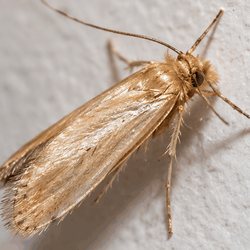
What is actually required depends on how many rooms are involved and how far activity has spread, which is why the useful thing to tell us when you call is not "I have moths" but "I have moths in these rooms, and I have found damage here".
- How many rooms show activity or damage
- Whether rugs, upholstery or stored textiles are involved as well
- Whether it is a house, a flat, a shared house or commercial premises
- Whether it has been treated before, and what was done
That takes a minute on the phone and it means the visit is booked with the right amount of time in it rather than adjusted on the day.
Why DIY Treatments So Often Fail
Traps, sprays and household products are not useless. Some are genuinely helpful for monitoring. They fail as a solution for specific and predictable reasons.
- Traps monitor, they do not treat. A pheromone trap catches adult males and tells you whether emergence is continuing. It removes no larvae
- Sprays reach open floor. Larvae are at the edges and under furniture, which is exactly where a quick spray does not go
- The furniture is not moved, so the main site is never treated
- Not every affected room is identified, and one untreated room resupplies the rest
- Rugs, stored woollens and upholstery are left out
- Treatment stops when adult sightings stop, which is the natural gap between generations rather than success
- The vacuum is not emptied, and a full bag in a cupboard is a small warm incubator
Professional Carpet Moth Treatment
- Confirming what you have. Carpet moths, clothes moths, food moths and outdoor moths need different responses, and it is worth thirty seconds to be sure
- Finding the food source. Carpet, underlay, rug, upholstery or stored textiles — this decides the whole job
- Establishing the extent. Which rooms and which items, including the ones where nothing has been seen
- Checking harbourage. Edges, under furniture, cupboards, stairs, rug undersides, storage
- Preparing the affected areas as required for the treatment being used
- Applying the appropriate professional treatment
- Cleaning and prevention advice, so it does not simply happen again
- Follow-up where the extent of activity warrants it
You will be given the preparation and aftercare instructions that apply to the treatment used on your property, including anything relevant to children and pets.
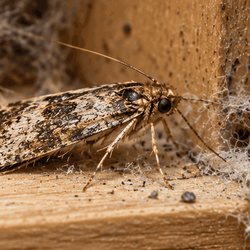
Preparing for Treatment
Requirements vary with the treatment and the property, and you will be told what applies to yours. In general:
- Vacuum affected carpets thoroughly, including the edges
- Empty the vacuum afterwards, outside, and dispose of the contents
- Move what furniture can practically be moved
- Clear access to carpet edges and skirting boards
- Set aside affected rugs and textiles rather than moving them to another room
- Follow any specific instruction about treated rooms afterwards
Do not strip the rooms out before we have seen them. The evidence of where activity is concentrated — the webbing, the debris, the damaged patch under the wardrobe — is exactly what a thorough clean removes, and it is what makes the treatment accurate. Wait until you have been told what preparation is actually needed.
Landlords, Tenants and Rental Properties
Carpet moth damage in a let property is expensive, and it is usually discovered at check-out when furniture is moved for the first time in a year. We take enquiries from landlords, tenants, letting agents, property managers and block management companies across Berkshire.
Where a deposit dispute or a managing agent's file needs something in writing, say so when you book and we will provide it. The period between tenancies is also, by a distance, the best time to treat a property properly — every room is empty and every edge is reachable.
Commercial Carpet Moth Control
Carpet moths are not confined to houses and flats. Offices, hotels, guest houses, care premises, clubs, shops and any managed building with wool carpet, rugs or stored textiles can all be affected, and in a large carpeted space an infestation can run for a long time before anyone connects the moths to the floor.
We accept commercial enquiries from businesses and managed premises throughout the service area.
Why Choose Pest Services Berkshire
- Professional carpet moth treatment from £220
- A published starting price rather than an estimate on the doorstep
- Domestic, rental and commercial work
- Landlord, tenant, letting and managing agent enquiries
- Twenty Berkshire towns covered, each with its own page
- Advice on preparation, aftercare and preventing a return
- A straight answer if what you have turns out not to be carpet moths