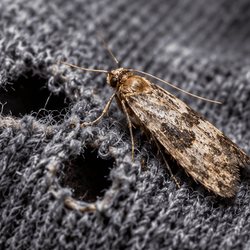
What They Look Like
Small, soft-bodied and cream or off-white, sometimes with a darker head. They are not fast and they are not conspicuous, and against a pale carpet they are genuinely hard to see even when you are looking directly at them.
Some carpet moth larvae carry a case around them — a small tube of silk with fibres from whatever they have been eating woven into it. That is why a case on a beige carpet is beige and on a dark rug is dark, and why they are so often mistaken for a bit of fluff or a piece of the carpet itself.
The practical consequence. You are unlikely to spot the larvae first. In almost every case what people find first is the DAMAGE, or the debris, and then the larvae once they know where to look. So look for the traces rather than the animal.
What They Leave Behind
- Webbing — fine, silky, irregular, sometimes with grains of debris caught in it. Not a spider web; much less structured
- Cases — small tubes, the colour of the material they have been feeding on, sometimes still occupied
- Frass — a fine sandy or gritty debris, again the colour of the food source. Finding it under a piece of furniture is one of the more reliable signs of active feeding
- Shed skins, which are translucent and very light
- Grazed pile — the fibres eaten down rather than cut, giving a thin or moth-eaten look rather than a clean hole
Where They Hide, In Order of Likelihood
- Under beds, particularly divans and beds with storage
- Under and behind wardrobes, sofas and chests of drawers
- The carpet edge against the skirting, all the way round a room and especially behind furniture
- Under rugs, and on their undersides
- Inside fitted cupboards, at the base and the back corners
- Stairs, at the outer ends of treads and in the tread-to-riser angle
- Rooms used least — spare bedrooms, dining rooms, studies
- Lofts, garages and stored boxes of textiles
- Wardrobes, at the shoulders of hanging wool garments
- Upholstery undersides, in the hessian and webbing
The pattern behind that list is simple: darkness, stillness and keratin. Anywhere all three are present for long enough will do.
How Long the Larval Stage Lasts
Longer than people expect, and it varies enormously with conditions. In a warm, heated room it is comparatively short. In a cool spare room, an unheated hallway, a loft or a garage it stretches out considerably.
That has two consequences worth knowing. An infestation in a cold space can persist quietly for a very long time rather than burning itself out. And a treatment's timing matters, which is why follow-up is sometimes recommended on a long-established problem.
Why Vacuuming Alone Does Not Finish It
Vacuuming is genuinely useful and it is not enough on its own.
- It reaches the open floor, which is the part larvae avoid
- It does not get under the furniture unless the furniture moves
- A domestic vacuum head does not sit properly into a carpet edge or a stair angle
- Eggs and cases can stay attached to fibres
- A full bag or cylinder left in a cupboard is a small warm incubator — empty it outside, every time
What To Do If You Find Them
- Do not move the affected item to another room to look at it in better light — that is how one room becomes three
- Photograph what you have found, with something for scale
- Note which rooms and which areas, because that is the information a treatment is built on
- Vacuum thoroughly and empty the vacuum outside
- Do not strip the room out completely before it is assessed
- Call. Treatment starts from £220
Carpet moths in Berkshire? Pest Services Berkshire treats carpet moths from £220. Carpet Moth Control Berkshire has the full detail, or call 0118 336 1366.