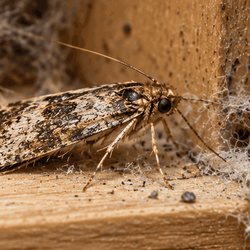
The question we are asked most often in Woodley is not how to get rid of carpet moths. It is why they came back. Somebody has treated a room, the moths went, and a few months later they returned — sometimes twice.
There is almost always a specific reason, and it is usually one of six. This page works through them in order of how often they turn out to be the answer. Pest Services Berkshire treats carpet moths across Woodley from £220.
Before the List: Are You Sure It Came Back?
Worth ruling out first, because it is common and it changes everything.
Adult carpet moths emerge in waves rather than continuously. After a wave, sightings fall away for weeks whether or not anything has been done. If a treatment happened shortly before a natural lull, the lull gets read as success and the next emergence gets read as a return — when in fact the infestation was never interrupted.
The test is damage and larvae rather than sightings. Mark the edge of a bald patch in pencil on the day of treatment and look again in six weeks. If it has grown, nothing was ever stopped.
Reason One: Another Room
By a distance the most common. The treated room was where the moths were SEEN, not where the larvae were. The infestation carried on in a spare bedroom, a landing, a dining room or a cupboard, and repopulated the treated room afterwards.
If only one room was treated and the house has other wool carpet, start here.
Reason Two: Something That Was Not Treated
A rug, particularly its underside, or one that was rolled up and put away
Stored woollens in a wardrobe, loft or garage
Upholstered furniture with wool covers or feather fillings
Curtains, at the hem
The underlay beneath the carpet, if the carpet itself is synthetic
A vacuum cleaner that was never emptied after the last clean
That last one sounds trivial and is not. A full bag or cylinder containing larvae, left in a cupboard, is a small heated incubator.
Reason Three: The Edges and Under the Furniture
If the treatment was a DIY spray, it very probably went onto open floor. Larvae are not on open floor. They are along the strip against the skirting, under the bed and behind the wardrobe, and a treatment that did not reach those has not addressed the infestation at all.
Reason Four: It Was Reintroduced
A second-hand rug, chair or sofa brought in since
Boxes brought down from a loft or back from storage
Items from another household — inherited, borrowed or passed on
Clothing bought second-hand
Timing is the clue. If the return followed within a couple of months of something arriving in the house, that is worth considering seriously.
Reason Five: A Neighbouring Property
In a semi or a terrace, the void beneath the floor and the gap behind the skirting on a party wall can be continuous. A heavy infestation next door can supply yours.
It is not an accusation and most people have no idea. It is worth a conversation if a properly executed treatment has failed twice, because it changes the approach.
Reason Six: An External Source
Old birds' nests in eaves, soffits or a loft are concentrated keratin and support the same insects. The clue is a seasonal rhythm — a return at roughly the same time each year — and moths appearing upstairs near ceilings or a loft hatch rather than at floor level.
What to tell us if you are on your second or third attempt. Which rooms were treated and which were not; whether furniture was moved; how long the gap was before they came back; whether anything was brought into the house; and whether the timing looks seasonal. That is genuinely most of the diagnosis, and it saves a visit.
Signs to Confirm It Is Active Now
Small moths close to the floor, running rather than flying
Irregular thinning or bald patches in wool carpet
Damage along carpet edges and against skirting
Bare areas revealed when furniture is moved
Fine webbing, larvae or shed cases in the pile
A marked patch that has grown since you marked it
Why the Larvae Stage Explains All Six
Every reason above comes back to the same fact. Adults are visible and harmless to your carpet; larvae are hidden and are the entire problem. Any treatment judged on adult sightings, and any treatment that does not reach where larvae actually live, produces exactly this pattern of apparent success followed by return.
Professional Treatment From £220
Confirming carpet moths rather than another household moth
Working through the reasons above to find why it recurred
Establishing every room, item and area actually involved
Preparing the affected areas as required
Applying the appropriate professional treatment
Cleaning and prevention advice
Follow-up, which on a recurring problem is usually worth having
On a third attempt, follow-up matters more than on a first. Say so when you book and it will be built into the plan rather than discussed afterwards.
Landlords, Agents and Commercial Premises
We take enquiries from landlords, tenants, letting agents and property managers across Woodley, and from businesses and managed premises with carpets, rugs or stored textiles.
Questions
Carpet Moth FAQs — Woodley
Why do carpet moths keep coming back after treatment?
Most often because another room was never treated, or because something was missed — a rug, stored woollens, upholstery, the underlay, or a vacuum that was never emptied. Reintroduction, a neighbouring property and an external nest account for most of the rest.
How do I know whether the treatment actually worked?
Judge it by damage and larvae, not sightings. Mark the edge of a bald patch in pencil on the day and look again in six weeks. Adults emerge in waves, so a few quiet weeks proves nothing.
Could it be coming from next door?
In a semi or terrace it can. The void under the floor and the gap behind skirting on a party wall are often continuous. It is worth considering if a properly executed treatment has failed twice.
It comes back at the same time every year. What does that suggest?
An external source, most often an old bird's nest in the eaves or loft. The seasonal rhythm is the clue, and so are moths appearing upstairs near ceilings rather than at floor level.
How much is treatment in Woodley?
From £220, depending on the rooms involved. On a recurring problem it is worth saying what has already been tried, because it changes the approach.
Advice
Carpet Moth Guides for Woodley
Five guides written for Woodley. We publish these in batches
rather than all at once, so some are still being written —
those are marked rather than linked to a page that is not there.
Treatment starts from £220. Tell us which rooms are affected and
what you have found — moths, larvae, webbing or damage —
and we will come back to you.