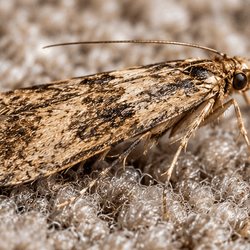
A lot of Thatcham's housing is relatively modern, and there is a widespread assumption that carpet moths are a problem of old houses with old carpets. They are not. They are a problem of wool, and there is more wool in a modern house than most people realise.
It is usually not the fitted carpet. Pest Services Berkshire treats carpet moths across Thatcham from £220, and on newer properties the job frequently starts with working out what is actually feeding them.
The Wool You Did Not Know You Had
Carpet moth larvae feed on keratin, the protein in animal fibres. In a modern house with synthetic carpet, that can still be present in several places.
Underlay. Felt and rubber-crumb underlays can contain animal fibre, and it sits directly beneath the carpet in permanent darkness. This is the most commonly missed source in a newer house.
Hessian backing. Jute is plant fibre rather than animal, but carpet backings and the adhesives and dressings on them can still support activity, particularly where soiled.
Wool rugs. Extremely common on top of synthetic carpet or hard flooring, and far more vulnerable than the floor they sit on.
Wool insulation where it has been used, particularly in a loft with stored items alongside it.
Upholstery and cushions with wool covers or feather fillings.
Felt in unexpected places: under piano keys, in speaker cones, in craft materials.
Why the underlay point matters so much. If the food source is the underlay, everything visible looks fine. The carpet is synthetic and undamaged, there are no bald patches, and the only symptom is moths appearing with no apparent explanation. People conclude the moths must be coming from outside and stop looking.
How They Get Into a New House
They are brought in far more often than they arrive on their own, and it is worth knowing the routes because that is what prevention actually consists of.
A second-hand rug, chair or sofa
Boxes of textiles from a previous address, or from storage
Wool items bought second-hand, including vintage clothing
Items inherited or passed on from another household
Occasionally, a bird's nest in the eaves or a loft
An adult through an open window, which is the least likely route and the one people assume
What to Look For, Given the Food Source May Be Hidden
In a newer property the standard advice — look for bald patches in the carpet — can come up empty while there is still an active infestation.
Small moths close to the floor, running rather than flying, and not drawn to lights
Moths appearing from the same area repeatedly
Larvae or shed cases at carpet edges, even without visible pile damage
Fine webbing in a corner, under a piece of furniture or in a cupboard
Damage to a rug — check the underside
Small holes in stored wool clothing or blankets
Lift a corner of the carpet at an edge if you can do so without damaging it, and look at the underlay
The Larvae Do the Feeding
Adult carpet moths do not eat anything. The larvae do, and they spend that stage somewhere dark and undisturbed. That is why killing the moths you see changes nothing lasting, and why a problem apparently solved reappears a few weeks later.
Rugs on Hard Floors
A specific case worth mentioning because it is common in newer housing. A wool rug on a laminate, tile or engineered floor is an isolated island of food, and the space beneath it is completely undisturbed.
It also means the infestation can be genuinely contained — which is good news, because dealing with one rug is a much smaller problem than dealing with a house. Lift rugs periodically and look underneath. It takes a minute.
Why DIY Treatment Often Misses It Here
Products go onto a synthetic carpet that was never the food source
The underlay beneath is not reachable and not treated
Rug undersides and stored textiles are overlooked
Traps monitor adults without removing larvae
Sightings fall between generations and it reads as success
Professional Treatment From £220
Confirming carpet moths rather than food or outdoor moths
Establishing what is actually feeding them — carpet, underlay, rug, upholstery or stored textiles
Establishing which rooms and areas are involved
Preparing the affected areas as required
Applying the appropriate professional treatment
Cleaning and prevention advice
Follow-up where the extent of activity warrants it
If your carpet is synthetic and you have moths anyway, say so when you call. It is a useful starting point rather than a reason to doubt yourself.
Landlords, Agents and Commercial Premises
We take enquiries from landlords, tenants, letting agents and property managers across Thatcham, and from businesses and managed premises with carpets, rugs or stored textiles.
Questions
Carpet Moth FAQs — Thatcham
My house is modern with synthetic carpet. How do I have carpet moths?
The food source is rarely the fitted carpet in a newer house. It is usually the underlay beneath it, a wool rug on top of it, upholstery, or stored woollens. Synthetic carpet rules out the carpet, not the house.
Can carpet moths live in underlay?
Felt and rubber-crumb underlays can contain animal fibre and sit in permanent darkness beneath the carpet. It is the most commonly missed source in modern housing, and it produces moths with no visible carpet damage at all.
I have a wool rug on a hard floor. Is that a risk?
It is the most likely source in that situation, and the space beneath it is completely undisturbed. The good news is that it is contained — one rug is a much smaller problem than a house. Lift it periodically and look.
How did they get into a new-build?
Almost always brought in: a second-hand rug or chair, boxes from a previous address or from storage, or wool items bought second-hand. An adult flying in through a window is the least likely route.
How much is treatment in Thatcham?
From £220, depending on the rooms and items involved.
Advice
Carpet Moth Guides for Thatcham
Five guides written for Thatcham. We publish these in batches
rather than all at once, so some are still being written —
those are marked rather than linked to a page that is not there.
Treatment starts from £220. Tell us which rooms are affected and
what you have found — moths, larvae, webbing or damage —
and we will come back to you.