Why the Rug Matters More Here
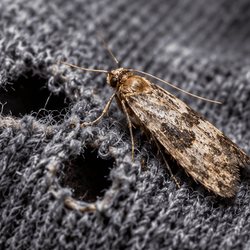
Carpet moth larvae eat keratin — the protein in animal fibre. They cannot digest polypropylene, nylon, polyester, laminate or vinyl.
- In a house with wool carpet, a population can live almost anywhere on the floor
- In a house with synthetic carpet, it has to find animal fibre — and the candidates are the underlay, upholstery, wardrobes, and rugs
- In a house with hard flooring throughout, a wool rug is often the single largest piece of keratin in the property
The upside of that. A contained food source is a contained problem. If the rug is the only wool in the house, dealing with the rug and the floor beneath it can genuinely be the end of it — which is not true in a house carpeted in wool throughout.
The Signs
- Turn it over. Damage starts on the underside against the floor, where it is dark and still. The face can look untouched
- Look at the covered parts — under a sofa, a coffee table, a bed
- Look for thinning, not holes. The larvae graze the pile away; on a hand-knotted rug they leave the foundation, so you see the grid of the weave
- Check the fringe and selvedge if either is wool
- Look at the hard floor underneath — debris and cases show up far more clearly on laminate or tile than they ever do in a carpet
That last point is a real advantage in a modern house. A sandy debris on a wooden floor where a rug has been sitting is obvious in a way it never is on carpet.
Rug Underlay and Grippers
Worth checking separately. Rug underlays vary — a modern felt-and-latex or natural-hair underlay is animal fibre and is food; a rubber or PVC anti-slip mat is not. If there is something under the rug, lift that too and look at both faces.
Treatment Options
Treated in place
Usual for an ordinary wool rug, and done together with the floor beneath it — the two reinfect each other and treating one without the other is why this comes back.
Taken out to a specialist
If the rug has real value, a natural dye or silk in it, bag it sealed where it stands and take it to a specialist rug cleaner or textile restorer. We treat properties; we do not clean, restore or value textiles, and a household product on an unstable dye does not come out.
Replaced
An inexpensive rug with widespread damage is often not worth saving. Bag it before it travels through the house, and do not store it in the garage as a maybe.
Preventing It Coming Back
- Move rugs and vacuum underneath them, both faces, every few months
- Check the floor beneath as well as the rug
- Do not leave a rug pinned under furniture for years without lifting it
- Check any second-hand or inherited rug before it goes down
- Keep the vacuum emptied outside, not into the kitchen bin
Treatment starts from £220. Tell us what the flooring is in each room as well as where the rugs are — in a modern house that is what narrows the job down.
Carpet moths in Thatcham? Pest Services Berkshire treats carpet moths from £220. Carpet Moth Control in Thatcham has the full detail, or call 0118 336 1366.