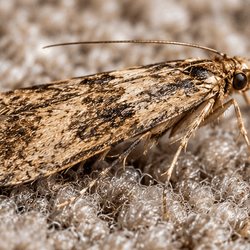
The Moths Are the Weakest Evidence You Have
Adult carpet moths do not feed on wool. They lay eggs on it. The feeding is done by the larvae, which are somewhere darker and quieter than wherever you saw the moth.
So a moth tells you to go and look. It does not tell you what you have, how bad it is, or where. Damage and larvae tell you those things, and finding them is the whole of this exercise.
Step One: Rule Out the Moths That Are Not These
Several small moths turn up in houses and most of them are harmless to your carpet. Getting this right first saves a great deal of unnecessary worry.
- Textile moths — small, buff or golden, reluctant to fly, found near floors and skirting, NOT attracted to lights. Disturb one and it tends to run rather than fly. This is the group that matters.
- Food moths — similar size, often with banded wings, found around kitchen cupboards. Their larvae live in flour, cereal, rice, birdseed and dried pet food. Check the cupboards, not the floor.
- Outdoor moths — larger, stronger fliers, drawn to lamps and windows on warm evenings. Not eating anything indoors.
The quickest single test. Are they interested in your lights? Carpet and clothes moths are not. If the moths in your house gather round a lampshade in the evening, they are almost certainly not the ones that damage textiles.
Step Two: Find Out What Your Floor Is Made Of
Carpet moth larvae feed on keratin — the protein in animal fibres. Wool is the common source. Nylon, polypropylene and polyester are not food and cannot sustain an infestation.
- Wool feels soft and springy and recovers slowly when pressed
- Polypropylene feels harder and more wiry
- A singed fibre is decisive: wool smells of burnt hair, synthetic melts into a hard bead
- A carpet label, a receipt or an offcut in the loft settles it fastest
If the carpet is synthetic that rules out the carpet — but not the room. The underlay beneath it may contain animal fibre, and a wool rug on top of it certainly does.
Step Three: Look Where They Actually Live
This is the part people skip, and it is the part that gives you the answer. Larvae need darkness and stillness, so they are never in the middle of a floor that gets walked on.
- Move something heavy. A wardrobe, a bed, a sofa, a chest of drawers. Properly out, not just to one side
- Look at the carpet that was underneath it, and at the strip against the skirting behind it
- Run your eye along every carpet edge in the room, all the way round
- Turn over any rug and look at the underside and the fringe
- Open the fitted cupboards and look at the base and the back corners
- Check the stairs, at the outer ends of each tread where nothing walks
- Repeat in the rooms you use least, which is where it is usually worst
What You Are Looking For
- Irregular thinning, grazed areas or bald patches — not neat round holes
- Small cream-coloured larvae in the pile, often with a fine case around them
- Fine silky webbing, sometimes with grains of debris caught in it
- Shed larval cases, which look like small grains of the carpet itself
- A fine sandy debris where something has been standing — this is frass, and it means active feeding
- Damage concentrated where the floor was covered rather than exposed
Active or Old? The Distinction That Matters
Damage does not repair itself, so a house can carry the marks of an infestation that ended years ago. Treating that achieves nothing.
- Active: live larvae, fresh webbing, loose frass, and damage that grows
- Probably old: bare patches with no webbing, no larvae, no debris, and clean edges
- The test that settles it: mark the edge of a bare patch in pencil and look again in four to six weeks. If it has grown, it is active
Do Not Judge It By Whether the Moths Stop
Adults emerge in waves rather than continuously, so sightings drop away for weeks at a time whether or not anything has been done. That natural lull is the single most common reason people conclude a problem has resolved when it has not.
If You Find It
Pest Services Berkshire treats carpet moths from £220 across twenty Berkshire towns. When you call, the useful information is which rooms show activity, what you found, and whether rugs, upholstery or stored textiles are involved.
And do not strip the rooms out first. The webbing, the debris and the damaged patch under the wardrobe are exactly what tells us where to treat, and a thorough clean removes all of it.
Carpet moths in Berkshire? Pest Services Berkshire treats carpet moths from £220. Carpet Moth Control Berkshire has the full detail, or call 0118 336 1366.