
Finding the Nest and the Way In
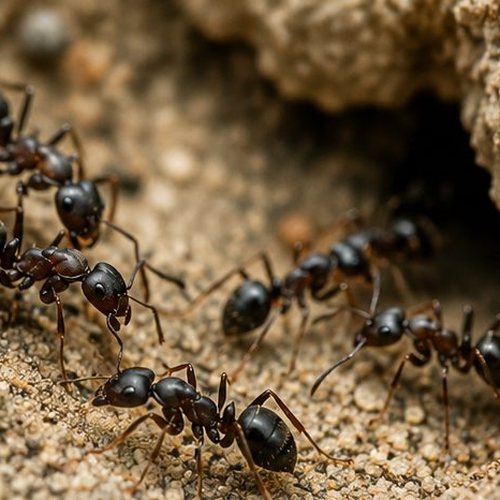
The ants indoors are the end of a route, so the first job is to walk that route backwards. That means watching where the trail enters the room, where it leaves the building and where it goes to ground outside. The usual finish is a line of fine soil or sand between paving slabs, a gap at the base of an outside wall or a disturbed edge to a patio.
Sometimes the nest turns out to be under the floor or in the base of a wall, with the ants coming up through a gap at the skirting or round a pipe. Sometimes there is more than one. Whichever it is, you will be told what has been found before anything is applied.
The Two Tools: Bait and Residual Treatment
Two approaches are used, alone or together, depending on where the nest is and how the ants move.
Gel bait
A bait gel is placed in small amounts in cracks and along the route, tucked out of reach. The foragers eat it and carry it back, and it is passed round the colony until it reaches the queen and the young. Bait is the answer when the nest cannot be reached directly, such as one inside a wall, and it is the only sensible approach for pharaoh ants.
Residual insecticide
Where the nest can be found, a residual insecticide is applied at the nest entrances, along the entry points into the house and at the base of the outside walls. It stays active on those surfaces, so ants crossing it pick it up over the following days rather than only at the moment it goes down.
Why You Still See Ants Afterwards
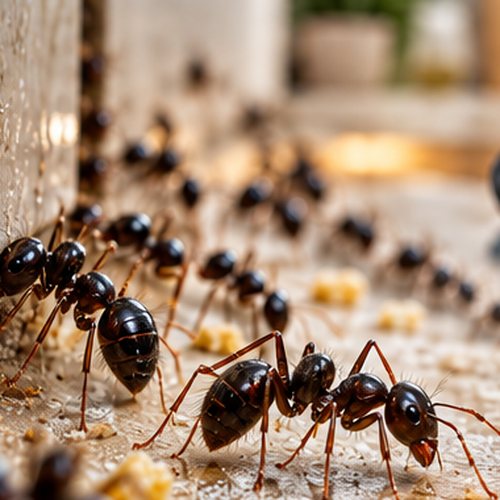
This is the part that worries people, and it is normal. Bait works by being carried, so for the first few days there can be as many ants about as before, or more, while the foragers collect it. A residual treatment takes a little time to reach the ants that were out when it went down.
What you should see is activity tailing off over a few days. What matters is the trend across the week, not the number on the first morning.
Leave treated areas and bait alone for the period you are told. Mopping the threshold, wiping the skirting or spraying your own product over the top removes the very thing that is working, and is the commonest reason a treatment seems not to have taken.
What You Are Told on the Day
- Where the nest or nests were found and what was used at each place.
- Which areas have been treated, and how long to leave them before cleaning.
- How long to keep children and pets off treated surfaces, which is at least until they are dry and as instructed.
- What to expect over the next few days, and what would mean ringing back.
- Which gaps are worth sealing once the ants have stopped.
Children, pets and treatment get a page of their own; the short version is to tell us at booking about children, pets, fish tanks and anyone vulnerable in the house, so the placement can be planned round them.
The Price and Booking
Ant control is a fixed £240, confirmed before anything is booked. What the treatment involves for your property is explained before you book, so there is nothing to work out on the doorstep. If you have been trying shop products first, what works at home is covered separately.