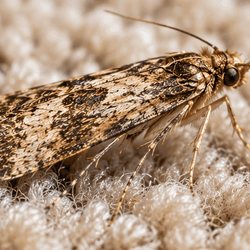
What You Are Looking For
- Larvae. Cream to off-white, up to about a centimetre grown, darker head, slow moving, usually inside a silk case that takes the colour of what it is eating
- Cases. Small silk tubes or bundles with fibre worked in. Look for a slightly raised texture where the surface should be even — this is what you actually spot
- Webbing. Fine silky threads across the surface, often holding grains of debris
- Frass. A fine sandy debris the colour of the fibre being eaten
- Eggs. Under a millimetre. You will not find them, so do not plan around it
Inspecting a Rug Without Harming It
- Take everything off it first. Do not drag furniture across a rug to get to the middle
- Roll rather than fold, pile side out, and roll along the length rather than the width. Folding creases a rug permanently and can crack the foundation of an old one
- Get help with anything large. A big rug lifted by one person at one corner takes the strain on a few threads
- Look at the underside in raking light — a torch held low and almost parallel shows texture that overhead light flattens
- Do not beat it, shake it hard or use a stiff brush. All three damage an old rug and none of them removes larvae reliably
- Vacuum gently, on low, with no beater bar, and never over a fringe. A beater bar on a hand-knotted rug is destructive on its own
Do not clean it yourself to solve the problem. Home shampoos, steam and solvents can lift natural dye, shrink wool and stain a foundation permanently. If the rug matters, a specialist rug cleaner or a textile restorer is the right call — and a separate call from the one about the room.
Inspecting Upholstery
- The underside, where the hessian and webbing are — this is where it starts on most upholstered pieces
- Under and behind loose cushions, in the crevices
- Along piping and seams
- Under the item, on the floor where it stands
- Behind a fixed back panel, which you should not attempt to remove on anything antique
On an antique or reupholstered piece with natural fillings — horsehair, feather, wool wadding — the food source is inside the furniture rather than on it. That is a real limitation and it is worth knowing before rather than after.
Inspecting Stored Textiles and Garments
- Take items out one at a time rather than emptying everything onto a bed
- Check shoulders, under collars, cuffs and folds — the parts that never move
- Look at the bottom of the wardrobe and the carpet under it
- Check anywhere a lining is layered or a badge is stitched
- Bag anything suspect before it travels through the house
Being Straight About the Limits
A pest control treatment addresses an infestation in a property. It does not restore a textile, it does not clean one, and it does not put back what has been eaten.
- Us: the room, the flooring, the environment, and stopping it continuing
- A specialist rug cleaner: cleaning without damaging dye or foundation
- A textile restorer or conservator: reweaving and repairing damaged areas
- An upholsterer: anything requiring a piece to be opened up
- Your insurer: worth asking, though most household policies exclude both insect damage and gradual damage, so expect the exclusion
Treatment starts from £220. If valuable textiles are involved, tell us what they are and where they are — it changes what we do in the room and what we advise you to keep out of it.
Carpet moths in Henley-on-Thames? Pest Services Berkshire treats carpet moths from £220. Carpet Moth Control in Henley-on-Thames has the full detail, or call 0118 336 1366.