The Four Stages
- Egg. Under a millimetre, off-white, pushed into fibre or a crevice near food. Effectively invisible without magnification
- Larva. Cream to off-white, up to about a centimetre grown, darker head, slow moving. Usually inside a silk case that takes the colour of what it is eating
- Pupa. Inside a case, often tucked into a corner, at a skirting or under an edge
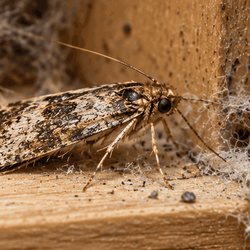
- Adult. Small, buff to mottled, runs or flutters low, avoids light. Does not feed
How Long Each One Takes
- Egg to hatch: roughly one to three weeks, faster in warmth
- Larva: the long one. Commonly two to three months, and it can stretch far longer in a cool or unheated room — this is the only stage that eats anything
- Pupa: a couple of weeks
- Adult: a few weeks, spent mating and laying
Warmth compresses all of it. A consistently heated house can run generations back to back through the winter; a cool one produces roughly one a year with a long larval stage.
Working backwards from an adult. The moth on your landing today was an egg somewhere between three and eight months ago, depending on how warm the house is. It did not arrive this week, and the female that laid it was here last year.
What You Will Actually Find, In Order of Likelihood
- Webbing. Fine silky threads across the surface, often with grains of debris caught in them
- Frass. A fine sandy debris the colour of the fibre being eaten
- Cases. Small tubes or bundles of silk with fibre worked in, the colour of the carpet. Look for a slightly raised texture where the surface should be flat
- Larvae. Usually only once you know to look for the case
- Adults. Which is what most people notice first, and which tells you the least
- Eggs. Realistically, not at all
Where To Look
- Under the heaviest item in each carpeted room
- The carpet edge against the skirting, all the way round
- Under rugs and on their undersides
- The base and back corners of wardrobes and fitted cupboards
- Stairs, at the outer ends of the treads
- The airing cupboard, among stored bedding
- Any room used less than the others
Use a torch held low and almost parallel to the surface. Raking light shows the texture of a case and webbing that overhead light flattens out entirely.
What the Stage You Find Tells You
- Live larvae and fresh webbing: active now, and treat now
- Empty cases and old grey webbing, no larvae: possibly historic. Mark the damage and check in a month
- Adults but nothing on the floor: the source is somewhere you have not looked — underlay, a rug, a wardrobe, a loft
- Everything at once, several rooms: long-running, and a whole-property job rather than a room
Treatment starts from £220. Tell us what stage you have found and in how many rooms — it is a better guide to the size of the job than anything else you can describe.
Carpet moths in Newbury? Pest Services Berkshire treats carpet moths from £220. Carpet Moth Control in Newbury has the full detail, or call 0118 336 1366.