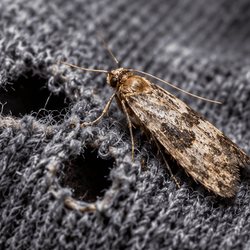
What Each Stage Actually Looks Like
- Eggs. Under a millimetre, off-white, laid in ones and twos pushed down into fibre or into a crevice. Effectively invisible without magnification — do not plan on finding them
- Larvae. Cream to off-white, up to about a centimetre when grown, with a darker head. Slow moving. Often inside a silk case they have built, which takes the colour of whatever they are eating
- The case. A small tube or bundle of silk with fibre worked into it. On a beige carpet it is beige. This is the reason people look straight at them and see nothing
- Webbing. Fine silky threads across the surface, often holding grains of debris
- Frass. A fine sandy debris, roughly the colour of the fibre being eaten
Look for the case, not the caterpillar. The larva is camouflaged by design. The case is a slightly raised, slightly textured object where the surface should be smooth, and once you have seen one you see them easily.
Where the Eggs Go in a Period Floor
A female pushes eggs into a crevice near a food source. In a house with bare or partly covered boards there are a great many crevices, and they are permanent.
- The gaps between floorboards. Decades of wool fibre, pet hair and dust have fallen in, and it is all edible. This is the most productive place to look and the least accessible
- The join where a board meets the skirting, and the gap behind a deep skirting
- Under the edge of a rug, particularly a rug that never moves
- Around and under gripper rods where a carpet is fitted in one room only
- The void beneath a suspended floor, which is dark, still and runs the footprint of the house
- Old underlay left down from a previous covering
How To Look, Without Lifting the Floor
- Use a torch held low and almost parallel to the floor — raking light shows texture that overhead light flattens
- Run a thin blade or a bank card along a board gap in a quiet corner and see what comes up
- Lift the corner of any rug and look at both faces plus the boards beneath
- Look along the skirting line all the way round, especially behind furniture
- Check any fitted carpet at its edges and under the heaviest item in the room
- Photograph what you find rather than clearing it
How Long Each Stage Lasts
Useful because it explains why the timing of what you see is not the timing of what is happening.
- Eggs hatch in roughly one to three weeks, depending on warmth
- Larvae feed for months — commonly two to three, and considerably longer in a cool room or an unheated house. This is the entire damaging stage
- Pupation takes a couple of weeks
- Adults live a few weeks, do not feed, and exist to mate and lay
So an adult on the landing in May represents eggs laid the previous autumn. Seeing the moth is the end of a process, not the start of one.
Treatment starts from £220. If your floors are boards with rugs rather than fitted carpet, say so on the call — it changes where we look and what the treatment has to reach.
Carpet moths in Windsor? Pest Services Berkshire treats carpet moths from £220. Carpet Moth Control in Windsor has the full detail, or call 0118 336 1366.