What a Nest in the Fabric Is Made Of
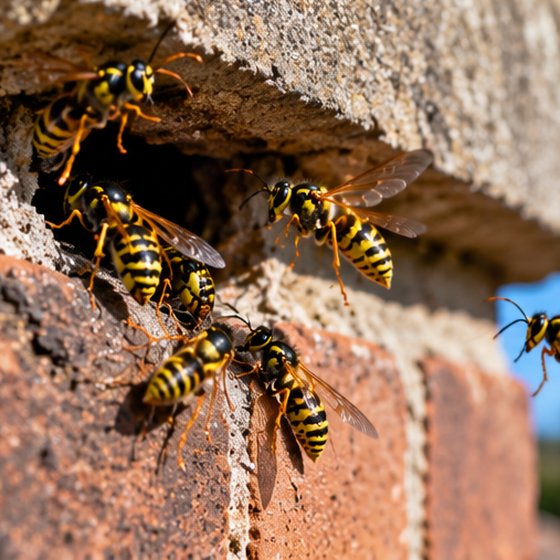
Chewed wood pulp and saliva, dried into something between paper and thin card. It is not corrosive, it does not set hard, and it does not bond to brick, timber or plasterboard. Structurally a nest weighs very little even at full size and sits against a surface rather than into it.
That rules out most of what people worry about. A wasp nest does not eat the timber it is attached to, does not gnaw cable the way rodents do, and does not undermine anything. The wood pulp came from weathered fence panels and dead branches outside, not from your roof.
What It Genuinely Can Do
- Stain a ceiling. A large colony directly above plasterboard can leave a damp brown mark. Uncommon, but it happens and it is the one that costs money to put right.
- Block ventilation. A nest built across a soffit void or against a vent path can restrict airflow the roof needs. Left for years, that is a condensation problem rather than a wasp one.
- Displace insulation. Not eaten, but pushed aside and compressed where a nest has grown down into it.
- Mark render or brick. Staining around a heavily used entrance, mostly cosmetic and mostly weathering off.
None of that argues for opening up a wall to remove a dead nest. All of it argues for not leaving a live colony in the fabric for several seasons running.
Surveys, Sales and Insurance
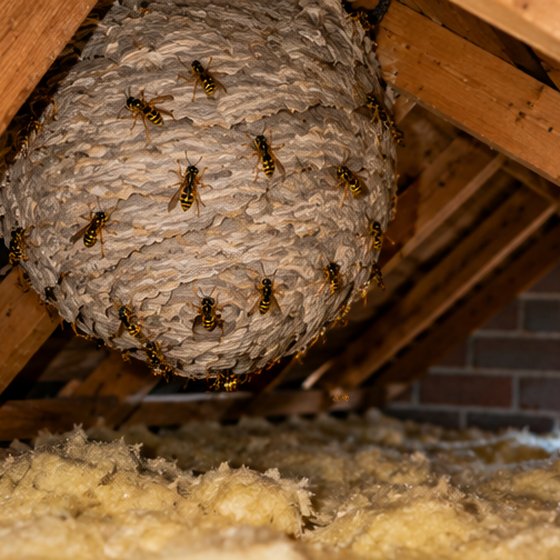
A live nest noted in a survey is usually recorded as a straightforward item to deal with rather than a defect, because that is what it is. An old dead nest in a loft is generally recorded as present and left at that. Neither normally holds up a sale, and the treatment is cheap enough that it is not worth a negotiation.
What can matter more is what the nest reveals. A surveyor noting wasps going in at a soffit end is also noting a gap at a soffit end, and that gap may be the actual finding. We are not surveyors and will not pretend otherwise — but it is worth knowing that the entrance is often the more interesting half.
Proofing Without Causing a Different Problem
The instinct after a nest in a soffit is to seal everything. Resist it. Soffit vents, airbricks and weep vents are there to keep the structure dry, and closing them to keep insects out trades an insect problem for a condensation one that is far more expensive.
Sensible proofing closes the gaps nobody intended — an unclipped verge unit, an open joint at the end of a soffit run, an eroded mortar bed, a missing bit of felt — and covers the intended openings with a fine stainless mesh that keeps the ventilation working. All of it is autumn and winter work, once any colony is finished.
The rule that applies to every position in the fabric: the entrance stays open until the colony is dead. Wasps blocked into a cavity chew inward, and inward is a room.