Why a Flue Suits Them So Well
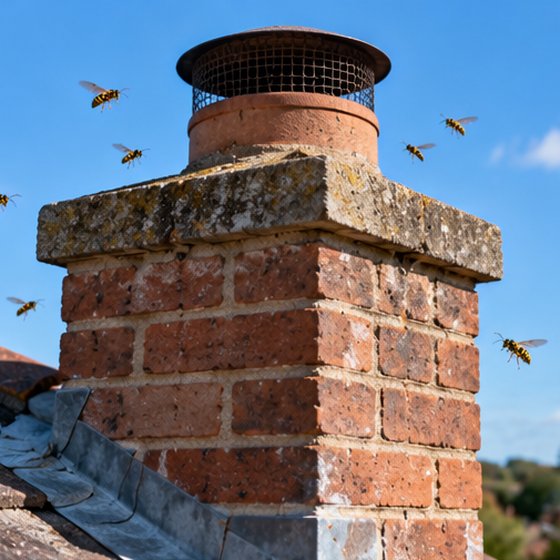
A disused flue is close to a wasp's ideal: dry, sheltered, warmer than outside, out of the wind, and with a small entrance at the top that nothing else wants. A colony will build a few feet down from the pot and can reach a considerable size before anyone notices anything at ground level.
The first sign is usually wasps circling the stack, which is easy to miss from below. The second sign is far harder to miss: single wasps appearing in the room with the fireplace, several a day, with no obvious way in.
Wasps Coming Down the Chimney
Wasps in the hearth do not mean the nest is in the room. It means the nest is in the flue above it and individuals are working their way down, usually through a gap round a register plate, a capped-off opening or an old air vent. They are disorientated rather than aggressive, which is why they end up at the window.
Do not light a fire to smoke them out. Smoke does not kill a colony. It drives wasps downward through whatever gap they have been using, which puts them in the room rather than the flue, and a paper nest in a lit flue is a fire risk in its own right.
How a Chimney Nest Is Treated
At the entrance, like any other — in this case the pot or the gap at the stack that the wasps are using. The nest deeper in the flue does not have to be reached, and the flue is not opened up. Where the stack cannot safely be reached from below, that changes the access rather than the method, and we will say so before coming out.
Sealing the room end while a nest is live is exactly the wrong order. Close the gap in the hearth and the wasps looking for a way out keep looking, and they find one somewhere less convenient.
Afterwards
Once the colony is dead the nest can be left in the flue if the chimney is disused. If the flue is in use, or about to be, it should be swept before anything is lit — an old nest is dry paper in a chimney, and that is worth removing properly rather than burning.
That is a sweep's job rather than ours, and it is worth doing after the treatment rather than before. A sweep's brush through a live nest is a bad afternoon for everybody.