
Underground and Invisible
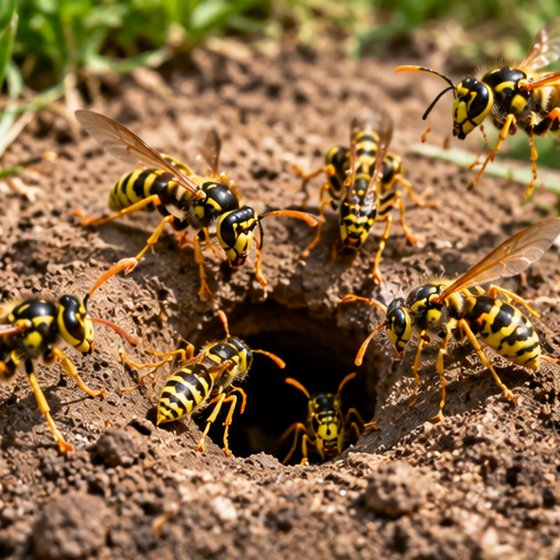
A ground nest is usually started in something that was already there — an old vole run, a mouse hole, a gap under a paving slab or a hollow at the base of a shrub. The colony excavates from that, so the whole nest is below ground and the only thing visible is a hole the size of a ten pence piece.
It can be surprisingly large by August, and it gives no clue from the surface. People generally find these in one of two ways: by noticing a steady stream of wasps low over the grass, or by running a mower across the entrance.
Why the Mower Is the Problem
Wasps respond to vibration near the nest as an attack on it. A mower, a strimmer or a rotavator passing over or near a ground nest triggers a defensive response from the whole colony at once, and the person holding the machine is standing directly over the entrance with the engine noise covering the first warning.
This is the single most common way people get multiple stings in a garden. It is also the reason a ground nest is worth dealing with even when it is somewhere nobody normally walks — because the grass still needs cutting.
How a Ground Nest Is Treated
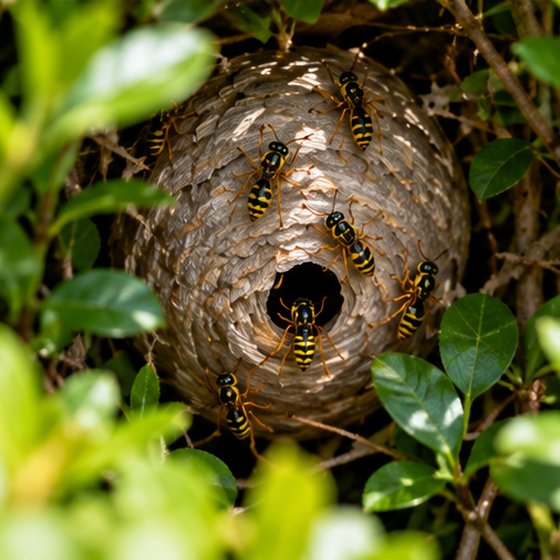
The entrance is treated directly and the wasps carry it down. Nothing is dug up, and the nest is left underground to break down on its own over the winter. Where the hole is in a lawn, there is nothing to make good afterwards.
Do not pour anything down it. Petrol, boiling water, bleach and expanding foam are all regularly tried on ground nests. None of them reaches a nest that may be a foot or more down and several feet across; all of them provoke the colony; and petrol into a lawn is a contamination problem long after the wasps are gone.
Before We Arrive
- Mark the spot from a distance — a cane a couple of metres away is plenty, and do not stand over it to do it
- Keep children and pets off that part of the garden entirely
- Do not mow, strim or rake anywhere near it
- Note whether there is more than one hole with traffic
Two holes a few feet apart are usually one nest with two ways out. Two holes at opposite ends of a garden are usually two nests, and that is worth knowing before the visit rather than after it.