
The Ten-Second Version
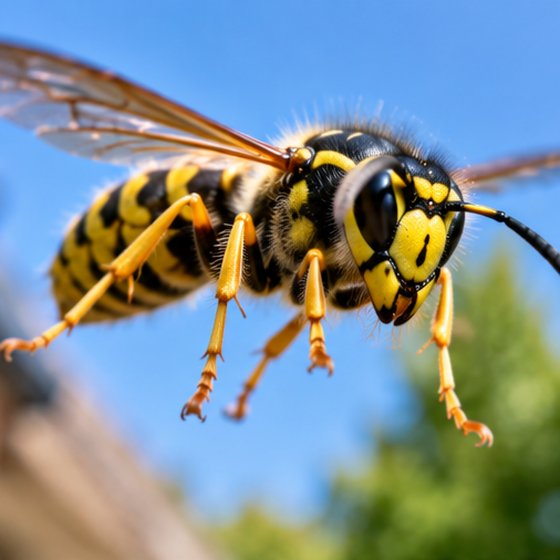
A common wasp is sharply banded in black and bright, hard yellow, with a smooth and almost shiny body and a very obvious narrow waist. In flight its back legs hang. A honey bee is furrier, more golden and brown than yellow, with no sharp banding and no pronounced waist.
A bumblebee is unmistakable once seen next to either — large, round, densely furry, and usually black with one or two bands and often a white or buff tail. A hornet is a wasp built to a larger scale, browner and more chestnut about the head and thorax, and far less inclined to bother anybody than its size suggests.
What They Build, and Where
- Wasps — grey papery nest, often with visible ridges and swirls, built in a void: a roof, a wall, a shed, a hedge or a hole in the ground
- Honey bees — flat waxy combs, usually in a chimney or a large cavity; a swarm hangs in the open as a dense clustered ball
- Bumblebees — a small untidy nest of a few dozen, often in an old mouse hole, a compost heap or a bird box
- Masonry bees — no nest at all, just individual bees going into separate small holes in soft mortar
What We Will and Will Not Treat
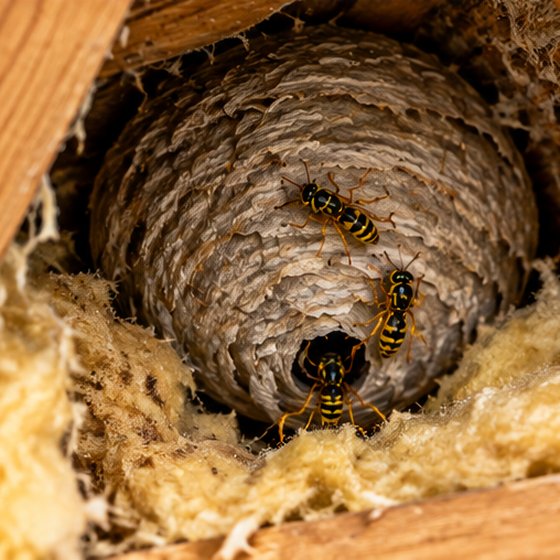
Wasps and hornets, yes. Honey bees, no — a swarm or an established colony in a chimney goes to a local beekeeper, who will often collect a swarm at no cost. Bumblebees are left alone wherever they possibly can be: the colony is small, it is done by autumn, and it will not be back in the same place.
Masonry bees are the one people most often want treated and most often should not. They are solitary, they do not defend anything, and the holes they use in soft mortar are almost always holes that were already there. The mortar is the issue, not the bees.
The quickest way to be sure: send a photograph on WhatsApp before you book anything. A clear picture of the insect, or of the nest, settles it in a minute and costs nothing.
If You Cannot Get Close Enough
Do not try. A photograph from a distance still helps, and so does a description of the traffic — wasps stream in and out of a single small hole, honey bees at a chimney work a broader area and come and go more heavily on warm afternoons, bumblebees trickle in ones and twos.
If it is genuinely unclear, that is a reason to ring rather than to guess. Nobody is charged for being told they have bees.