
Wasps, But No Nest in Sight
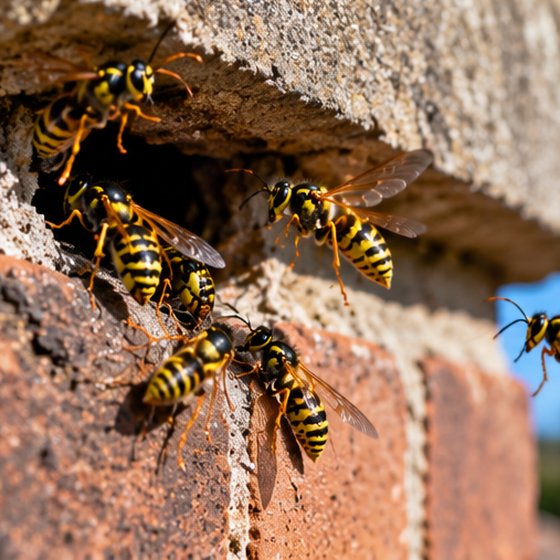
Seeing wasps around a property tells you very little on its own. A foraging wasp will travel a few hundred metres from home, so wasps at a bin or a fallen apple may belong to a nest three gardens away that is nobody's problem. What matters is not how many wasps you can see but whether there is a route.
A nest announces itself by traffic. Stand well back, pick a point on the building and watch it for sixty seconds. If wasps are arriving and leaving from the same spot in a steady two-way stream, that is the entrance. If they are drifting about at random with no pattern, they are foragers and the nest is somewhere else.
Where the Entrance Usually Is
The entrance is almost never a hole anybody built. It is a gap that happens to exist: the slot behind a soffit board, a lifted roof tile, a missing bit of mortar, the joint where a conservatory meets the wall, an airbrick, a gap round a waste pipe, or a hole in the ground the size of a ten pence piece.
The nest is often some distance inside from that entrance. Wasps coming and going at a soffit may be nesting several feet along the roof void; wasps at an airbrick may have built inside the cavity at first-floor level. This is why treating the entrance matters more than reaching the nest, and why a nest you cannot see is not a problem.
Worth doing before we come: note the point they are going into and roughly what height it is. Those two facts change what gets brought to the door, and they are the quickest thing you can give us on the phone.
When There Is More Than One
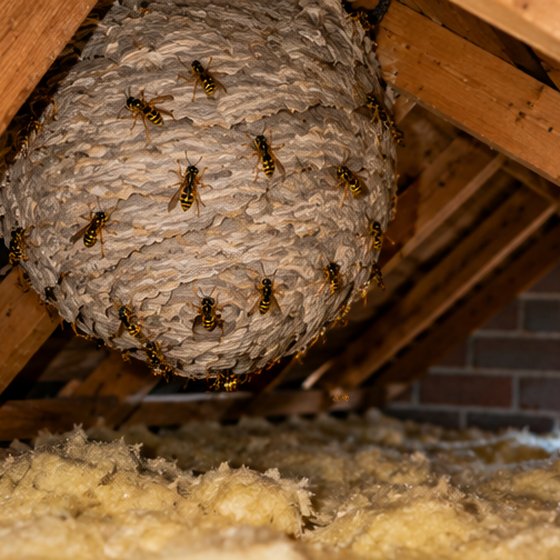
Two entrances on the same building sometimes mean one nest with two ways in, and sometimes mean two nests. The way to tell is to watch both: one nest with two entrances shares its traffic, so activity rises and falls at both together, while two colonies run independently of each other.
It is worth establishing before treatment rather than after. A second nest treated on the same visit is straightforward; a second nest discovered a fortnight later reads, understandably, as a treatment that did not work. We will tell you what we find before anything is applied.
What Happens Once It Is Found
Treatment goes in at the entrance, not into the building. Wasps walk through it coming and going, carry it inside on their bodies, and it moves through the colony to the queen. Nothing has to be opened up, no ceiling comes down, and the nest itself is left where it is.
Expect the activity to increase for a while before it stops. Foragers that were out when the entrance was treated come back to it, so for a period there are visibly more wasps at that spot, not fewer. It is the treatment working rather than failing.