The Four Things That Decide It
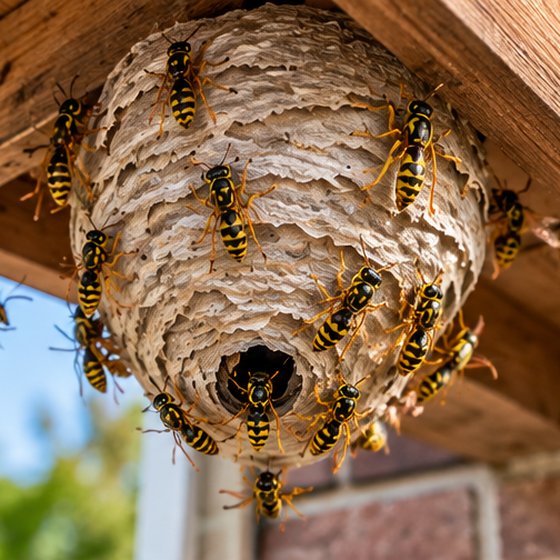
- Size and time of year. A walnut-sized nest with a single queen in April is a different object from a football with several thousand workers in August. Almost all of the risk sits in the second half of the season.
- Position. At arm's length in the open is one thing. Above head height, up a ladder, inside a confined space, or with the entrance between you and the way out is another.
- Who is nearby. Children, pets, neighbours, a shared garden or a public path change the consequence of getting it wrong, not just the chance.
- Allergy. If anybody in the household carries an auto-injector for insect stings, this stops being a cost question.
Where the Answer Is Genuinely Yes
An early-season nest, golf-ball sized or smaller, in the open, at or below shoulder height, on a property with nobody vulnerable, with a clear route to walk away — a shed rafter in May, say — is manageable. At that stage there may be one queen and a handful of workers, and knocking it down in the evening when it is cool is a real option.
Nobody needs to pay us ninety pounds for that, and we would rather say so. What makes it work is that the colony is tiny; what makes the same action reckless in August is that it is not.
Where the Answer Is No
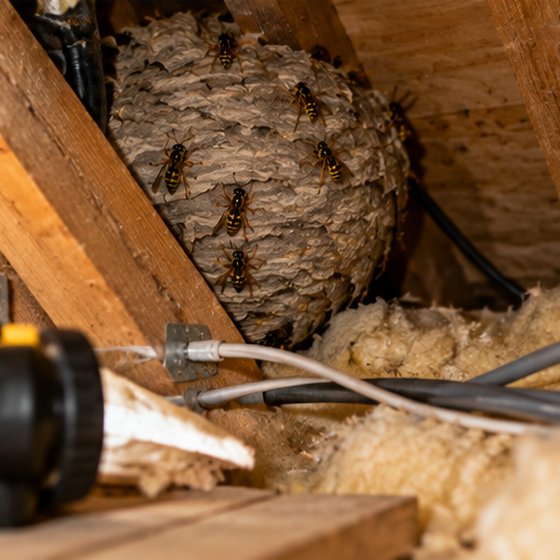
Anything in a loft or a confined space. Anything needing a ladder. Anything in a wall, a cavity, a chimney or the ground. Anything from late July onwards. Anything where somebody in the household reacts badly to stings. Those are not cautious lines, they are where the ambulance calls come from.
The loft and the ladder are the two that recur. A loft puts the colony between you and the hatch in poor light on an uneven floor; a ladder puts you where a defensive reaction has no safe outcome even if you are not allergic. The sting is rarely the injury in a ladder case.
What the Shop Product Does and Does Not Do
An aerosol kills the wasps it lands on at the entrance. It does not reach a queen and brood inside a structure, and a colony with a live queen replaces the workers. So it produces a visible result, no lasting one, and an agitated nest — which is the worst combination for whoever goes back the next day.
The professional difference is not a stronger chemical. It is placing something at the entrance in a form the wasps carry inside themselves, so it reaches the queen. That is the whole mechanism, and it is what an aerosol cannot do from the outside.
The Cost Comparison, Honestly
A can is a few pounds and a treatment is ninety. If the nest is small, early and in the open, the can may well be enough and you have saved the difference. If it is not, the can is a few pounds spent making the job harder, and the ninety is still due.
If in any doubt, send a photograph on WhatsApp before deciding. We will tell you if it is one you can deal with yourself, and nobody is charged for that answer.