
Why Old Buildings Suit Mice So Well
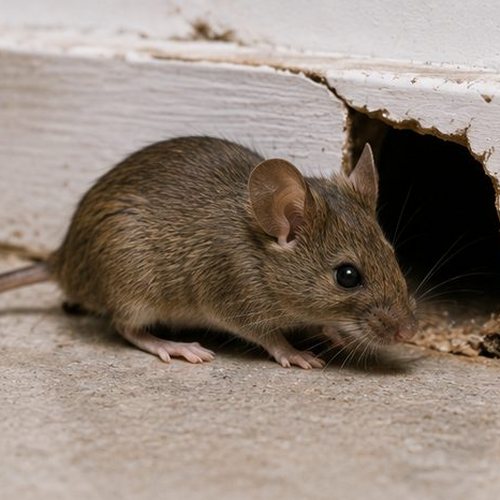
Older houses were not built to be sealed boxes. Mortar was softer and wears into holes over the decades. Floors were laid on joists above an open void. Walls were plastered on lath, leaving a thin cavity behind. Services were added long after the house went up, each one punched through the fabric wherever it was convenient.
Put together, that gives a network of dry, quiet voids linked by small gaps. A mouse needs a gap only about the width of a pencil, and a century of settlement, alteration and repair leaves plenty of those. None of it is neglect; it is simply how these buildings are.
The Voids That Matter Most
- Under the floors. Suspended timber floors sit over a void that often runs the length of the house. Mice move freely through it and come up wherever a floorboard, pipe or skirting leaves a gap.
- Behind the walls. Lath and plaster, dry lining added later and old boxed chimney flues all give sheltered routes between rooms and floors.
- Around the chimney breast. Disused fireplaces, blocked-up grates and the gaps where hearths meet the floor are common crossing points.
- Cellars and roof spaces. The two ends of the house are the least disturbed, and both connect to everything in between.
Under-floor voids and skirting in Victorian and Edwardian houses are covered in more detail on the Caversham page, and the roof space on the Hungerford page.
Airbricks: Protect Them, Never Block Them

Airbricks are the small grilles low down on the outside walls. They ventilate the void under a suspended floor, and without them the timbers can rot. Old clay airbricks often have cracked or missing sections, and a broken one is an open door.
The one thing not to do: never fill or cover an airbrick to keep mice out. Fit fine metal mesh behind or over it so air still flows. Blocking it swaps a mouse problem for a damp and rot problem.
The same principle applies to vents in a cellar or at the eaves: the building relies on them breathing. Mesh keeps mice out and lets the air through.
Treating Without Opening Up the Building
Nobody wants floorboards lifted or plaster cut in a period room, and it is rarely needed. Bait stations and traps are placed where mice are travelling, which in an old house means at the points where the voids open into rooms: behind the base of a cupboard, beside a pipe rising through the floor, at an access hatch into a cellar or loft.
What an old building does mean is patience. There are more places to hide and more routes to cover, so activity can take a while to fade, and a mouse that dies inside a void may smell for a time before it dries out. That is unpleasant but it does pass, and it is one reason the survey spends time on where the voids actually run.
Proofing an Older House Afterwards
Once activity has stopped, the gaps can be closed, and in an older property the choice of material matters. Soft brick and lime mortar should be repaired with a matching lime mix rather than hard cement, which traps moisture and damages old masonry. Wire wool packed into gaps and finished with a suitable filler or mortar works well round pipes; expanding foam alone does not.
What proofing is sensible for a particular house is explained before booking, along with the fixed £260 price, which is confirmed before anything goes ahead. On a listed building, check with the conservation officer before altering the fabric, even for something as small as a new vent grille.