
Why Modern Homes Still Get Mice
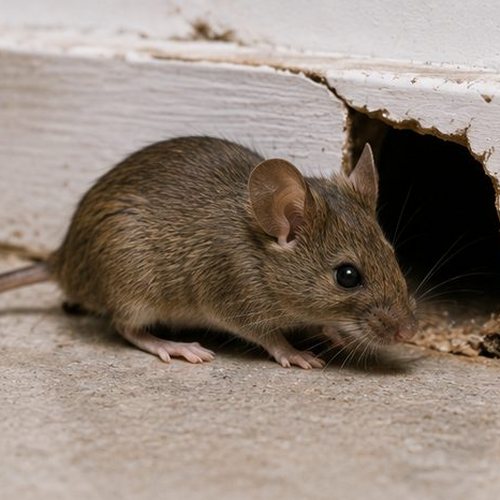
Post-war and more recent houses usually have solid floors, tighter roofs and cavity walls, which gives mice far fewer ways in than a Victorian terrace. What they do have is services: water, gas, waste, electricity, telephone, broadband, TV aerials and boiler flues, each one needing a hole through an outside wall.
Those holes are made larger than the pipe or cable to get it through, and the gap round it is not always filled properly. A mouse can get through a gap about the width of a pencil. Over the years, extra cables get added, old ones removed and the holes left behind, and each one becomes a possible way in.
Where Pipes and Cables Come In
- Under the kitchen sink, where water supply and waste pipes pass through the outside wall.
- Behind the washing machine or dishwasher, where waste pipes go out.
- Around the boiler, where the flue, gas pipe and condensate pipe pass through.
- At the meter boxes, where the gas and electricity supplies enter the house.
- Where cables come in for broadband, phone and TV, often through a hole drilled near a window frame.
- At air conditioning or heat pump pipes, which are often fitted later and sealed loosely.
The one place to look first: the back of the cupboard under the kitchen sink. Pipes go through the wall there, the gap round them is often rough, and it opens straight into the space behind the units.
The Cavity Wall as a Route

Once a mouse is into the cavity between the inner and outer skins of the wall, it can travel sideways and upwards to wherever the next opening is. That means a gap at the meter box outside can lead to mice appearing behind the fridge or even in the loft. The route in and the place you see them may be some distance apart.
Weep vents, the small slots low in the brickwork, drain the cavity and need to stay open, but they can be covered with fitted guards to keep mice out. Working out exactly which route mice are using on your own property is covered on the Twyford page, and newer homes with boxed-in pipes and integral garages on the Thatcham page.
Treating a Modern Home
Treatment goes where mice travel between the entry point and where they feed, so in a modern house that often means under the kitchen units, behind appliances and in the boiler or airing cupboard. Rodenticide goes only in locked, tamper-resistant stations, and traps are placed where only mice can reach them. Mention children, pets or anyone vulnerable in the house when you book.
Mice control is a fixed £260, confirmed before anything is booked. What the treatment involves, including the visits and any proofing, is explained before you commit. In Bracknell and nearby towns the survey spends time on the service entry points, because that is usually where the answer is.
Sealing Round Services Afterwards
Once activity has stopped, the gaps round pipes and cables can be sealed. Wire wool packed into the gap and finished with filler or mortar is hard for mice to chew; expanding foam on its own is gnawed through quickly. Take care round gas pipes and electrical cables: if in doubt, leave it to a qualified tradesperson. The materials and methods are set out in how to mouse-proof your home.