
The Building Is One Territory

A mouse does not know where one flat ends and the next begins. Walls between homes are rarely sealed at every point: floors run continuously under several properties, roof spaces over a terrace are often open or only partly divided, and pipes for water, heating and waste pass straight through party walls with gaps round them that nobody ever sees again.
Those spaces are dry, warm, dark and undisturbed, which is exactly what mice want. A family of mice can nest in a void under one flat and feed in the kitchen of another, and neither household will see the whole picture on its own.
Where Mice Cross From Home to Home
The crossings are usually in the same handful of places, because they follow the services:
- the boxing round soil stacks and risers that climb through every floor of a block;
- the gap under the kitchen units, where the plinth hides pipes entering from the wall behind;
- the void beneath a suspended floor that carries on under the house next door;
- roof spaces over a terrace where the dividing wall stops short of the tiles;
- meter cupboards, bin stores and communal hallways in converted houses.
The full list of ways into a building is in how do mice get into houses. What matters here is that in a shared building the route is often internal, from next door, not from outside.
Why Treating One Flat Alone Can Fall Short
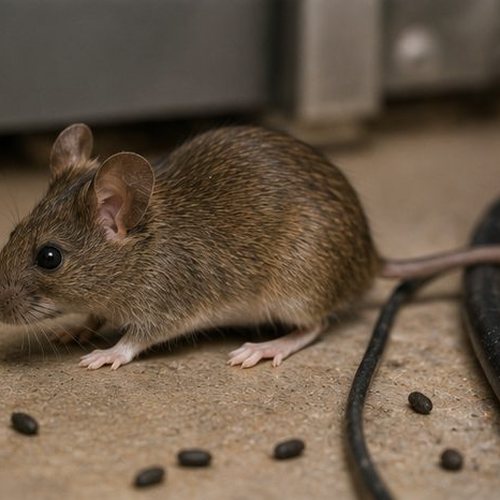
Treatment in a single flat will deal with the mice that feed there. It cannot reach a nest under the neighbour's floor, and if that home has food lying about, mice keep being born next door and keep exploring along the same routes. You get a quiet spell, then fresh droppings, and it looks as if the treatment failed.
The one thing that makes the difference: talk to the neighbours on either side, and the management company if there is one. Mice in one home of a joined building are very rarely only in that home.
That conversation is usually easier than people fear. Most neighbours are relieved to hear it is not just them. Where a whole block is affected, the freeholder or management company is normally the right body to arrange treatment of shared areas, and we can speak to them directly.
Sealing a Shared Wall Without Trapping Mice In
Blocking the gaps between homes is part of the answer, but timing matters. Seal a route while mice are still using it and some are shut on your side with no way out, where they either chew a new hole or die somewhere in the void. The order is always treatment first, then proofing once activity has stopped.
Gaps round pipes where they pass through a party wall are best packed with wire wool and finished with filler or mortar; expanding foam on its own is chewed straight through. Anything that is part of the structure of a block, or covered by a lease, needs the freeholder's say-so first.
What It Costs and How It Is Arranged
Mice control is a fixed £260 per property, confirmed with you before anything is booked. What the treatment involves, including how many visits and any proofing, is explained at that stage. If neighbours want treating at the same time, each home is arranged separately, and it helps to tell us which flats or houses are involved when you ring.
If the problem keeps returning even after a careful job, the likely reasons are set out in why do mice keep coming back.