
Start With the Edges of the Room

Mice travel close to a wall, and in a Slough terrace or block the walls that matter most are the shared ones. Droppings, smears and gnawing tend to cluster along a party wall, round the line of a pipe, or beside the boxing that hides a riser, far more than in the middle of a room.
Look wherever something passes through a wall or floor:
- Under the kitchen sink, where waste and supply pipes leave through the back or the floor.
- Behind the washing machine and in the boiler or airing cupboard, where pipe holes are rarely tidy.
- Round the bath panel and the skirting where a radiator pipe comes up through the floor.
- Along the party wall in a built-in wardrobe or under the stairs.
Fresh droppings are dark, soft and slightly shiny. Old ones are grey and crumble. If you clear a spot and fresh ones are back in the same place within days, that spot is on a route in regular use.
Noises: Above, Beside or Below?
Scratching and scampering after dark are often the first thing people notice. In a building with other homes around you they are also the hardest sign to place, because sound travels along joists, pipes and boxed-in ducting and can be loudest nowhere near the mice.
A few observations help more than a guess:
- Time. Mice are mostly active at night. Noise that stops by morning fits mice; noise in the middle of the day does not.
- Direction. Is it overhead, in the wall beside the bed, or under the floor? Try listening in a second room.
- Weight. Light scurrying suggests mice. Heavy thumps or gnawing sounds can point to something larger, which is covered in our guide to noises in walls and ceilings and in telling mice from rats.
Signs That Point Next Door
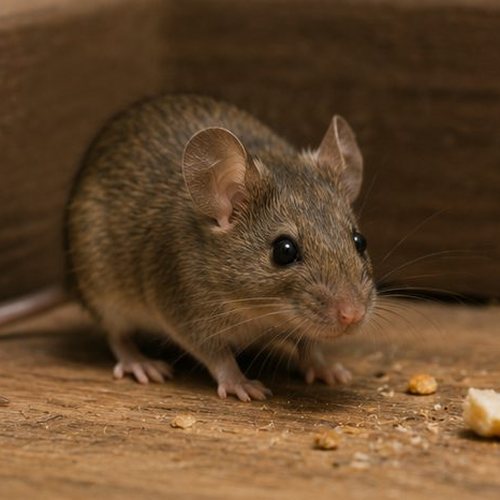
Mice in a joined building rarely stay in one home, so what you see on your side may only be part of the picture. These patterns suggest the main activity is elsewhere:
- Noise on one side of a room only, with no droppings on your side at all.
- Droppings only where a pipe or the party wall meets the room, and nowhere else.
- Droppings that reappear quickly after cleaning, in the same place.
- A musty smell near a shared wall, a shared stairwell or a bin store.
- A neighbour who has seen or heard the same thing.
None of these proves it on its own. What they tell you is that dealing with the mice in your home is worthwhile, and that closing the gap they use on your side matters just as much. That is what professional mice control in Slough sets out to do.
Signs in the Shared Parts
Stairwells, bin stores, meter cupboards, riser cupboards and any shared roof space belong to the building rather than to one flat. Droppings or gnawing there should be reported to the freeholder or managing agent in writing, with the date and a photograph. A written report also helps if you rent, as the tell the landlord first advice explains.
One clue is a prompt; a pattern is an answer. Fresh droppings plus gnawed packaging in the same cupboard, or noise on several nights running, is enough to act on. Write down what you find and when.
When to Call
Call us if you find fresh droppings in more than one place, gnawing on food or cables, a nest, noise on several nights, or a mouse in daylight. It helps to tell us where and roughly when you saw each sign, whether you live in a flat or a house, whether you own or rent, and whether neighbours have mentioned anything.
Mice control in Slough is a fixed £280 per property, confirmed with you before anything is booked. Please do not block holes yourself first: sealing while mice are still inside can shut them in. The full checklist of signs is in what are the signs of mice in your home, and the likely routes in are listed in how do mice get into houses.