
The Pencil-Width Gap
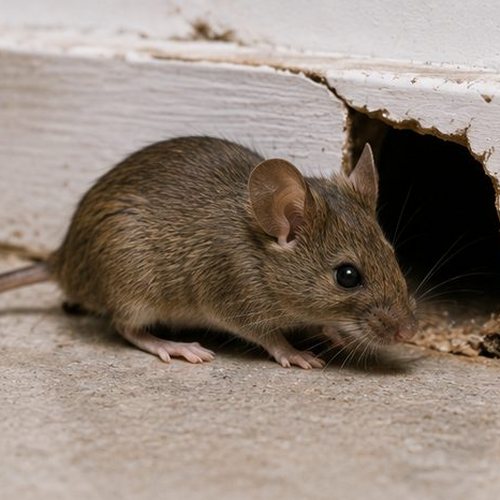
A mouse can squeeze through a gap roughly the width of a pencil, about 6mm. Its skull is the widest hard part of its body, and if the head fits, the rest follows. That is why a gap that looks far too small to matter often turns out to be the whole problem.
Rats need noticeably bigger openings. So when people say they have checked the house and there is nowhere a mouse could get in, they have usually been looking for something the size of a fist, not the size of a pencil.
Where Services Come Through
Every pipe and cable that passes through an outside wall leaves a gap round it, and these are the most common routes of all.
- Under the kitchen sink. Waste pipes and water supplies often pass through a hole cut larger than the pipe.
- Boilers and flues. Gas pipes, condensate pipes and flue openings, often at the back of a cupboard nobody looks in.
- Washing machine and dishwasher waste. A hole drilled through the wall and never properly filled.
- Cables. Telephone, broadband, aerial and electricity cables coming in at skirting level or through a window frame.
- Outside taps and overflows. Small pipes, loose gaps.
Airbricks, Doors and Low Gaps

Older airbricks with wide or broken openings let mice into the void under a suspended floor, and from there they come up beside pipes and behind skirting. Weep vents in cavity walls can do the same. Airbricks must never simply be blocked, because they ventilate the floor; they are covered with fine metal mesh instead.
The gap under an external door, particularly a back door or a door into the garage, is often wider than it looks at the corners. Worn door brushes, gaps round cat flaps and loose frames all count.
Garages, Utilities and Extensions
Garages, utility rooms and conservatories are built to a looser standard than the main house and often connect to it through a shared wall full of pipe runs. Mice get into the garage easily, then find the gap where a pipe or cable passes into the house. Extensions add another weak point where new walls meet old.
Roofs, Shared Walls and Stored Goods
Mice climb well. Rough brickwork, ivy, drainpipes and climbing plants all give them a way up to the eaves, where gaps behind fascia boards, missing mortar at the roof edge and loose tiles lead straight into the loft.
In terraces, semis and flats, mice also move between homes through shared lofts, floor voids and the space round shared service pipes. The route in may start next door, which is why a block or terrace sometimes needs more than one home looked at.
Finally, some mice are simply carried in: inside boxes brought back from a garage or shed, sacks of bird seed or pet food, firewood, or furniture that has been in storage.
Most houses have more than one possible route. The one that matters is the one the mice are actually using, and that is found by the evidence round it: droppings, smears and gnawing at the gap.
Finding and Sealing Yours
Knowing the list is the start. Working out which gap your mice are using is covered on our page about tracing the way in on your own property, and the materials that stop mice chewing straight back through are in how to mouse-proof your home.