
Snap Traps: Good for One or Two

A well-set snap trap is the most useful thing you can buy. It works, in Crowthorne or anywhere else, when it sits on a run, flat against the wall with the trigger end facing the skirting, because mice travel along edges rather than across open floor. A trap in the middle of the kitchen floor will mostly catch nothing.
- Use several, not one, spaced along the route where droppings are.
- Bait with a tiny amount of something sticky, such as a smear of peanut butter, so it has to be worked at.
- Check every morning, wear gloves, and bag what you catch.
- Keep traps where children and pets cannot get to them, or inside a cover.
For a single mouse that has wandered in, that may be the whole job. If you are still catching them after a week or two, you are dealing with a population, and trapping is only removing the ones that happen to pass.
Live-Catch Traps and Glue Traps
Live-catch traps need checking often, because a trapped mouse suffers quickly, and the mouse then has to be released well away from any home. Let it go at the end of the garden and it will likely be back inside, or in next door's kitchen.
Glue boards are a different matter. Since April 2024 it has been an offence in England to use a glue trap on a rodent without a licence from Natural England, and those licences are only granted in exceptional cases. If you have some in a drawer, do not use them.
Shop Poison: What It Does and Does Not Do
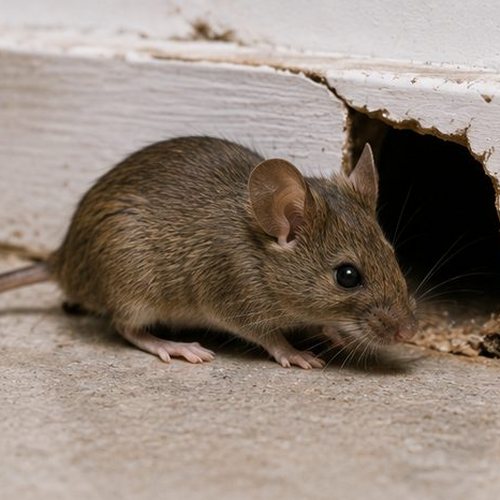
Poison bought over the counter can kill mice, but it has three drawbacks that catch people out. The first is that a poisoned mouse does not die where you can find it. It goes back into the floor, the wall or the loft, and the smell arrives a few days later.
The second is that poison left in open trays or scattered sachets is a real risk to pets and children, and to any other animal that finds it. Only ever use it exactly as the label says. How bait is kept secure in a home with children or animals is covered on our page about bait boxes.
The third is the one that matters most. Poison deals with the mice that eat it and nothing else. The gap they came through is still open, so the next ones walk straight in.
The honest limit of DIY: traps and poison deal with mice already inside. They do nothing about the way in, and while that stays open you are clearing the house for the next ones.
When to Stop and Ring
It is worth calling if you are still finding fresh droppings after a fortnight of trapping, if you are hearing them in more than one room, if there is gnawing on cables, or if you simply cannot find where they are getting in. Waiting rarely helps, as our article on whether mice leave by themselves explains. A wider comparison of home products and professional treatment is on our advice centre.
Tell us what you have already put down and where, including any poison, so it can be removed or taken into account. The price is a fixed £260, confirmed before booking, and what the treatment involves, including visits and any proofing, is explained before you book.