
Why a Newer House Still Gets Mice
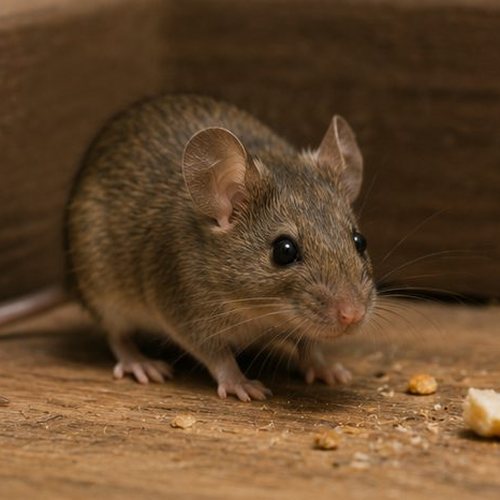
Recent building methods leave a surprising amount of hollow space. Plasterboard on battens or studs, boxed-in soil pipes, service risers and ceiling voids between floors all create sheltered, connected spaces that nobody ever looks into. For a mouse that is ideal: warm, dark and close to a kitchen.
Getting in needs very little. A mouse can pass through a gap roughly the width of a pencil, and new houses have plenty of those where services come through the wall, where a weep vent has lost its cover or where a sealant bead has shrunk. The full list of ways in is set out in our article on how mice get into houses.
Boxed-In Pipes and Service Voids
The boxing round a soil stack or a heating pipe is often the main road through the building. It runs floor to floor, it is rarely sealed at the top or bottom, and the hole where the pipe leaves through the outside wall or the floor slab is usually cut larger than the pipe.
- The kickboard space under fitted kitchen units, open to the wall behind.
- The cavity behind the bath panel, where supply and waste pipes drop through the floor.
- The cupboard housing the boiler or the meters, where pipes and cables enter together.
- The void between the ground-floor ceiling and the floor above, reached from any of these.
Droppings in more than one of these, on different floors, usually mean a single route rather than separate problems.
The Integral Garage
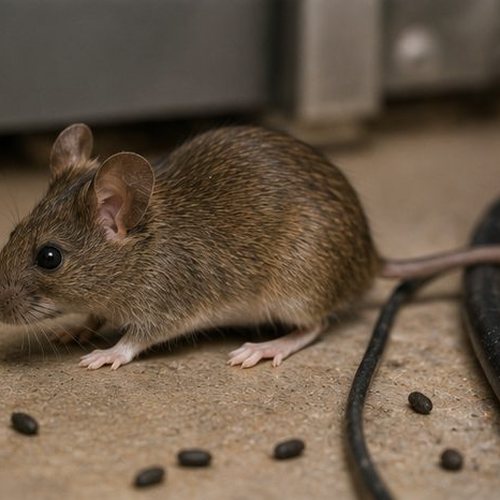
A garage built into the house is the weak point we would check first. The up-and-over door rarely fits tightly at the bottom corners, the garage is cool and quiet, and people store bird seed, pet food and boxes there. From the garage, a mouse only needs a gap round a pipe in the shared wall, or round the door into the hall, to be inside the house.
The room above the garage deserves attention as well. Its floor is the garage ceiling, and that void often connects straight to the rest of the first floor. Noise over a bedroom that sits above the garage is a common way these problems come to light.
What makes the difference: in a modern house the mice are travelling inside the building's hidden spaces, so the job is finding where those spaces meet the outside. Treating the kitchen alone, with the route still open, rarely ends it.
Dealing With It Without Pulling the House Apart
Very little needs opening up. Bait stations or traps go where the mice are running: under the plinths, in the loft, in the garage and at the service cupboards. Meanwhile we look for where the voids are reached from outside. If you want to follow the route yourself, our page on tracing how they get in walks through it, and the materials that hold up are covered in our mouse-proofing guide.
Sealing waits until the mice inside are dealt with. Close the gaps too early and they are shut inside the boxing, where they either chew a new way out or die in a place you cannot reach. The price is a fixed £260, confirmed before booking, and what the treatment involves, visits and any proofing included, is explained before you book.