
The Void Under the Floorboards

Most houses from before the First World War have suspended timber floors on the ground storey. The boards sit on joists over a shallow open space, and that space is kept dry by air flowing in through the airbricks in the outside walls. For a mouse it is ideal: dark, sheltered, undisturbed and connected to every room above.
Mice in a suspended floor are why people hear scratching under the sitting room, find droppings along a hall skirting nowhere near the kitchen, or see a mouse appear from a gap by the fireplace. The void runs under the whole ground floor, and in many semi-detached and terraced houses it links up with the one next door beneath the party wall.
Behind the Skirting and Round the Hearth
Old skirting boards were fixed over rough plaster and uneven brickwork, and many have a gap behind them or a split at the bottom where the floor has shrunk away. Mice use that gap as a corridor. A small, clean-edged hole at the base of a skirting, often with grease staining round it, is one of their doorways.
Blocked-up fireplaces are another. The chimney breast is often hollow at floor level, the hearth may have gaps round it, and a board fixed over the opening rarely fits tightly. Add the old gas pipes, lead water pipes and wiring that have been rerouted through floors and walls over the decades, and there are routes few owners know about.
Airbricks: Guard Them, Never Block Them
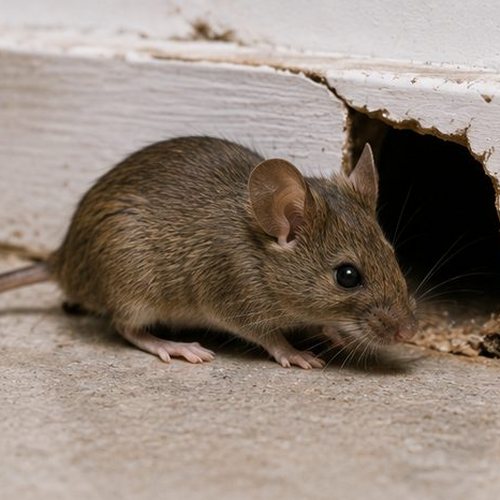
The obvious move, once you realise mice come in under the floor, is to block the airbricks. Do not. Without that airflow the void gets damp, and damp floor timbers rot. The answer is to fit fine metal mesh over any airbrick with broken grilles or wide gaps, so air still passes but mice do not.
The air under the floor has to keep moving. Cover a damaged airbrick with metal mesh rather than filling it. A sealed airbrick swaps a mouse problem for a timber problem, and the timber problem costs far more.
The broader methods and materials for sealing gaps are covered in how to mouse-proof your home. In a period house the same rule applies as anywhere: seal once the mice inside have been dealt with, not before.
How Treatment Works in a House Like This
Because the mice are living in the void, the treatment has to reach where they run rather than only where you see them. That can mean lifting a board or two, using an existing hatch, or placing locked bait stations at points where the void opens into the room. Traps and stations go on their runs, against the wall, where only mice can get to them.
Expect activity to tail off over days to weeks rather than stop on the first night. Mice that die under a suspended floor may smell for a while, and we will be honest about that rather than pretend it never happens. The price is a fixed £260, confirmed before anything is booked, and what the treatment involves, including visits and any proofing, is explained before booking.